Austria

Death Ridge Trail

Introduction
The official name of this trail is Welser-Höhenweg, “the High Wels Trail,” and it runs entirely along the Totes Gebirge range, whose name translates rather dramatically as the “Dead Mountains,” 

In reality, however, the landscape is anything but lifeless.

The range earned its name from the barren, limestone plateaus that characterise part of the trek, where vegetation is sparse and the scenery can feel almost lunar. Yet less than two hours after stepping off the bus, you’ll find yourself standing in a lush alpine meadow beside a traditional Austrian mountain hut.

Over the course of the journey, you will stay in no fewer than five such huts - warm, welcoming refuges serviong hearty local food, homemade desserts and, naturally, excellent Austrian beer.

This is a moderately easy trek with a wide variety of accommodation options and truly spectacular scenery. The dramatic rocky plateaus and snow-dusted peaks gradually give way to sparkling lakes, rolling green slopes and peaceful valleys, before the route finally returns to civillisation in the historic spa town of Bad Ischl, where hikers can soak their sore muscles in the famous thermal springs. 
01·Day by day

6 hiking days

Death Ridge Trail - 1
Day01
Hinterstoder → Prielschutzhaus
Grade
2
Length
6.7 kmkm
Ascent
872 mm
Descent
63 mm
Time
03:10
Continue a few dozen meters southwest from the bus stop at Hinterstoder Schiederweiher to reach a large parking area, where the atmosphere of the trek begins immediately beneath the dramatic silhouette of Spitzmauer (2,446 m). Cross the bridge over the fast-flowing, green waters of the Steyr River and enter a broad forest path that leads gently into the mountains. 

After about half a kilometer, the trail passes a small clearing beside the vividly green Schiederweiher pond, one of the best spots along the route to photograph the Spitzmauer peak that will dominate the landscape throughout the day. The path continues through the forest for another kilometer before opening onto a wide meadow, where the Polsterstüberl event hall stands at its center. When weddings or private events are not taking place, it offers a pleasant place to stop for a drink or a light meal.

From here, the trail returns to the forest, and roughly four kilometers from the starting point the ascent toward the Prielschutzhaus hut begins. The climb is moderately challenging, gaining elevation steadily through wooded terrain. Less than half a kilometer into the ascent, a short detour leads to the Klinserfall waterfall, the first major point of interest on the trek. In midsummer, the waterfall may be reduced to a small flow, with the pool below partially dry, but after rain or earlier in the season it is far more impressive.

Beyond the waterfall, the trail continues climbing through the forest for approximately two kilometers, alternating between gentler and steeper sections, until reaching the Prielschutzhaus hut, where you will spend the night beneath the towering slopes of Großer Priel. Experienced hikers can choose to summit the mountain the following day.

Death Ridge Trail - 2
Day02
Prielschutzhaus → Welser Hütte
Grade
2
Length
8 kmkm
Ascent
744 mm
Descent
448 mm
Time
03:20
Head northwest toward Großer Priel. Within the first kilometer, the forested landscape of the previous day gradually gives way to low alpine shrubs, and after roughly two kilometers the terrain opens into the stark limestone plateau that gives the Toten Gebirge range its distinctive, almost lunar appearance. The route follows a mostly gentle ascent through a barren landscape of pale rock formations, occasionally marked by wooden or metal summit crosses visible on nearby peaks. Early in the hiking season, lingering snowfields often blend into the gray limestone, adding to the stark beauty of the scenery.

After approximately two more kilometers, you will reach the Temlbergsattel pass at 2,063 meters, where several marked trails converge. Trail 261 branches left toward the summit of Temlberg and offers exceptional panoramic views, but the main route continues in the opposite direction, turning north onto trail 263. From here, the ascent remains gradual as the trail crosses open alpine terrain toward another junction marked by three weathered signs. At this point, follow trail 215 toward the Fleischbanksattel pass at 2,124 meters.

For hikers who start early and feel confident tackling a more demanding route, this is the point where trail 262 branches off and later connects with trail 260, leading to the summit of Großer Priel, the highest peak in the range. The summit is marked by a large red iron cross that remains visible from much of the day’s route and rewards the climb with sweeping views across the surrounding Alps.

Those not attempting the summit should continue descending along trail 215 toward the Welser Hütte. The descent can be steep in sections but remains straightforward. Perched high above the surrounding valleys, the hut occupies a dramatic and isolated setting, with numerous trails branching off toward nearby peaks of varying difficulty. Hikers arriving early and still feeling energetic may choose to explore one of these additional routes. Some, however, require technical mountaineering experience, so it is advisable to consult the hut staff regarding current conditions and the suitability of the surrounding climbs.

Death Ridge Trail - 3
Day03
Welser Hütte → Pühringerhütte
Grade
2
Length
9.09 kmkm
Ascent
603 mm
Descent
689 mm
Time
03:23
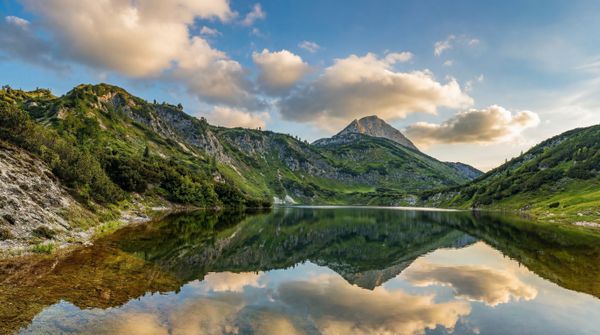
Leave the hut and follow trail 215 up to Fleischbanksattel Pass at an elevation of 2,124 m. From there, continue to the remains of the Schutzhohlz mountain shelter. Keep heading southwest, still on trail 215, with gentle ascents and descents until you reach Rotkogelsattel Pass at 1,999 m. From this point, the path descends steeply for about a kilometer before easing considerably. Here, the barren, moonlike landscape gives way to vegetation, with conifer trees gradually reappearing. From this point, the route becomes pleasant and easy, leading to the picturesque Pühringerhütte, located near Lake Elmsee.
Death Ridge Trail - 4
Day04
Pühringerhütte → Albert-Appelhaus
Grade
2
Length
10.3 kmkm
Ascent
445 mm
Descent
451 mm
Time
04:10
Leave the hut and continue southwest on the gently ascending trail, passing Lake Elmsee along the way. After approximately thirty minutes, you will reach a small group of wooden cabins known as Elmgrube. Here, the main route to the overnight stop climbs steeply to the right. Before continuing, however, it is highly recommended to make the short detour to Vorderer Lahngangsee.

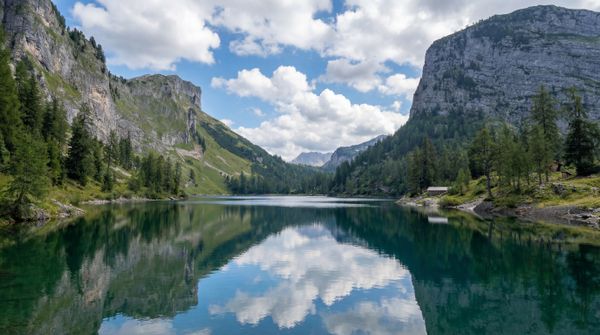
To reach the lake, continue southeast on trail no. 214 instead of turning right toward the ascent. The path descends gradually through the forest, and after about half a kilometer you will notice the small Hinterer Lahngangsee on your left. This lake is not directly accessible from the trail and can only be reached via a separate path branching from Vorderer Lahngangsee below. Continuing another half kilometer downhill brings you to the eastern shore of Vorderer Lahngangsee, an excellent place to rest or stop for a picnic. Surrounded by steep cliffs and dense forest, the lake has a distinctly alpine atmosphere reminiscent of the Rocky Mountains.

After visiting the lake, return to the main route and follow trail no. 201 toward the Albert-Appelhaus hut. Unlike the previous days, the landscape gradually becomes greener as you progress. The route first crosses open grassy slopes dotted with shrubs and conifers, while the pale limestone terrain slowly gives way to dense, low alpine vegetation that covers the surrounding hillsides and creates a striking contrast with the rocky peaks above.

Just before reaching the Abblasbühel pass, you will find a black plastic pipe on the left side of the trail carrying spring water. The water is considered safe to drink, though filtering it is still recommended. Beyond the pass, the trail becomes easier, winding gently between limestone ridges and cliffs with only moderate ascents and descents. After roughly five kilometers, the route begins a gradual descent through woodland toward the Albert-Appelhaus hut, your overnight stop for the day.

Death Ridge Trail - 5
Day05
Albert-Appelhaus → Ischler Hütte
Grade
3
Length
16 kmkm
Ascent
1100 mm
Descent
1362 mm
Time
05:30
When you leave the Albert-Appelhaus hut, make sure you have enough water with you. This day is expected to be long, quite technical, and challenging, with no natural water sources along the way (unless you have a water filter, which you can use to refill at Wildensee Lake, located about 3 km from the hut). 

The trail begins with an easy walk to the lake, where you can take a short break. From there, continue toward the limestone plateau, where you can admire the unique, barren landscape of ridges and peaks with their distinctive shapes, such as the Großer Scheiblingkogel, rising to 2,020 m, or its smaller northern neighbor, the Kleiner Scheiblingkogel, at 1,962 m. Pay close attention to the red and white trail markings in this area, as the path can sometimes be difficult to follow. 

 Around 8 km from the hut, you will reach a junction marked with yellow signs. Both trails, 230 and 228, lead to the same mountain, Schönberg, which stands at 2,090 m. However, the two routes are very different: trail 228, the shorter one, is highly challenging and technical, and not recommended for those without experience in mountain climbing techniques. It is especially inadvisable in cloudy weather or when strong winds are blowing. The trail is very exposed and includes sections where ropes are needed for support. 

Trail 230, although longer and looping widely around the problematic ridge, is much safer, and the views along it are no less impressive. The ascent to Schönberg is particularly enjoyable and offers stunning panoramas of the entire area. From the summit, marked by an iron lattice cross, the trail descends steeply to your overnight stop, the Ischler Hütte.
Day06
Ischler Hütte → Bad Ischl
Grade
1
Length
14.3 kmkm
Ascent
190 mm
Descent
1100 mm
Time
03:15
The day begins with a short climb to the edge of the small valley where you spent the night. From there, a fairly steep forested descent starts, offering stunning views for about 3.5 kilometers. As you continue, the slope becomes much gentler and almost unnoticeable. Along the way, you will pass several alpine huts while following the course of the Rettenbach River and its gorges. 

Eventually, you will arrive in the historic Austrian town of Bad Ischl. This is where Emperor Franz Joseph spent 83 of his 86 summers, and you can visit the imperial villa (Kaiservilla) where he stayed. 

Once the summer capital of the Habsburg dynasty, the town is, as its name suggests, a spa destination, one of the first in the world, and a perfect place to relax after the trek. The thermal springs are a treat for sore muscles. Here you will find excellent restaurants and multiple options for accommodation.
02·Map room

Route map & GPX files

Download GPX
03·FAQ

Before you set out

How to get there?

Everything you need to get from the city with the closest international airport to the start of the trek.

From Wien Westbahnhof train station in Vienna, take the IC train toward Stainach-Irdning and get off after 1 hour and 15 minutes at Linz (Linz Hbf). From there, take the RE train toward Selzthal and get off after 1 hour and 3 minutes at Hinterstoder. From the station, take bus number 431 (departing every hour on the hour), which will drop you off in 17 minutes at the Hinterstoder Schiederweiher stop, the starting point of your trail. If you prefer not to wait for the bus, consider taking a taxi from the train station.
How to get back?

Everything you need to know to get back from the trek's end point to the city you came from.

From the Bad Ischl train station, the endpoint of your trek, an ÖBB train will take you to Attnang-Puchheim in 59 minutes. From there, take an ÖBB Intercity train back to Vienna (Wien Meidling) in 1 hour and 55 minutes.
Where to sleep?

A hotel room, refuge, or tent? All the options for this hike including tips, guidelines, and a summary of local rules around bivouacking.

According to local regulations, wild camping is strictly prohibited in this area. However, the huts along the trail are spacious and generally available throughout the season, though they can get a bit crowded on weekends and holidays. It is still recommended to book in advance, just to be safe.
Good to know:

Important info, enrichment details about the hike, interesting anecdotes, recommendations, food, culture, and more to make your trip more successful.

The Welser Höhenweg is a well-marked trail, with the route typically indicated by a white stripe between two red stripes. On the fifth day, however, there is a more mountainous section where some of the markings are faded, so extra attention is required. It is recommended to use the navigation files available under “Logistics and Options” during this part of the trek. Humanity’s favorite outdoor hobby: trusting half-faded paint on rocks at 2,000 meters above sea level. Remarkable system.

Clean, safe drinking water is available near every hut along the route. Streams and lakes can also serve as water sources if you carry a water filter. A recommended filter model, along with consumable gear, energy bars, and trail food, can be ordered through this website and delivered to your accommodation before the trek begins. This allows hikers to avoid carrying excessive amounts of water during the ascents.

On the second and third days, the trail passes beneath the Großer Priel, the highest peak in the Toten Gebirge range at 2,515 meters. Experienced hikers may choose to summit the peak for panoramic views of the surrounding mountains and valleys, particularly on clear days.

At the beginning of the fourth day, which is considered a relatively short and easy stage, the Vorderer Lahngangsee lies about 1.5 kilometers off the main trail. The lake is well worth the detour, especially during hot summer weather, when its cold waters offer an inviting place for a swim. Surrounded by narrow shorelines and larch trees, the landscape has a distinctly North American feel, reminiscent of alpine lakes in Canada or the northern United States.