
How can you tell if you're fit enough to do your chosen trek?
Everything you need to know about the fitness levels required for different types of trek, and how to best prepare for more challenging routes.
(If you want to jump straight to the training plan that will get you into peak shape in just 6 short weeks, Click here)
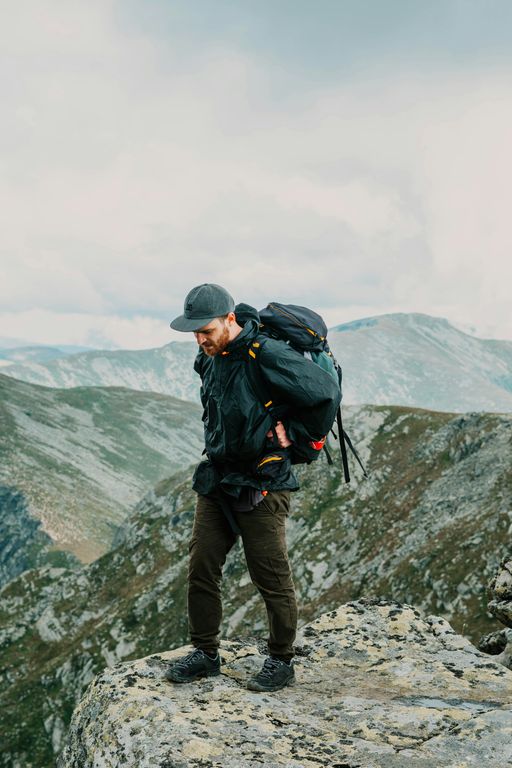
There’s nothing more frustrating than setting out on a trek only to realise, halfway through, that it’s far more physically demanding than you expected. Those moments of exhaustion rarely happen at convenient points, either - they usually hit in the most remote, exposed sections of the trail, far from any easy exit back to civilisation.
The good news is that with the right preparation, most of these situations can be avoided. This guide will help you understand the fitness level required for different types of treks, recognise which routes may be beyond your current limits, and learn how a few simple training habits can prepare you for even the most demanding adventures.
First of all, our Our detailed rating system already does much of the work for you. Each trek is graded using three separate parameters for every day of the journey, making it easy to identify routes that match your current fitness level. If you know you’re out of shape, simply avoid anything above Level 2. It’s as straightforward as that.
For Level 1 and 2 treks, no special fitness is required — just a reasonable level of persistence and motivation. In fact, many truly beautiful and rewarding routes fall into these categories, and most people should be able to enjoy them without major physical difficulty.
But what if you discover an incredible trek that’s rated Level 3 or higher?
From this point on, being in “good shape” becomes important. The problem is that “good shape” can mean very different things depending on the activity. You might go to the gym five times a week, do CrossFit, or run 2,000 meters in seven minutes and assume you’re perfectly prepared for trekking. Yet that kind of fitness does not always translate well to long days on the trail.
I learned this the hard way with a friend of mine from France named Vlad. He’s incredibly fit — the kind of person with almost no body fat, completely obsessed with CrossFit. I’ve watched him flipping tractor tyres back and forth until I got tired just standing there. But on a Level 4 trek I once took him on, he completely ran out of energy and ended up struggling behind me, even though I’m heavier and objectively less athletic than he is.
Why? Because trekking demands a very specific type of endurance. It’s not about explosive power or short bursts of intensity. It’s about sustaining steady physical effort for hours at a time, often uphill, carrying weight, over difficult terrain, day after day.
Treks are about two main forms of effort:
So yes - even if you have visible abs, impressive triceps, and can flex your chest muscles on command, it probably won’t help you very much on a trek. Unless the route involves a lot of scrambling — steep sections where you need to climb with your hands, usually found on Level 4 and 5 treks — upper-body strength is not what matters most.
Trekking is primarily an endurance activity. The effort is mostly aerobic: relatively low in intensity, but sustained for hours at a time. Unsurprisingly, the muscles that matter most are your legs.
The good news is that reaching the necessary fitness level is far more achievable than most people think. With consistent preparation, even someone starting from an average fitness level can dramatically improve within six weeks — enough to physically handle many Level 5 treks. (Important note: this refers only to physical fitness, not mental resilience or technical mountain skills, which are completely different subjects and will be covered separately.)
The even better news is that you don’t need an expensive gym membership. In fact, all you really need is access to a staircase — ideally one with several continuous flights — and later on, a backpack and a few bottles of water to add weight.
If you already go to the gym, then unfortunately you’ll need to become familiar with everybody’s favourite torture device: the stepper. As your training progresses, you can add a 10 kg weighted backpack or harness to better simulate the demands of trekking with full gear.
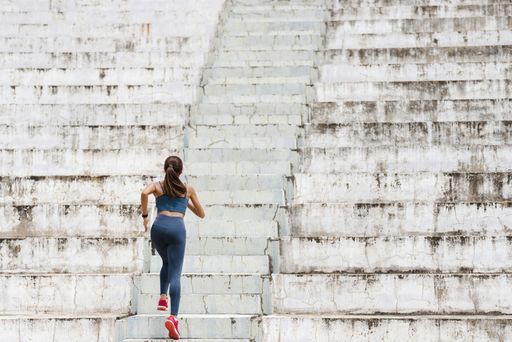

A super simple training plan that will get you into excellent "alpine" shape in just 6 short weeks:
Begin this program six weeks before your departure date. That gives your body enough time to gradually adapt to the type of endurance required for trekking without overtraining or risking injury.
This workout should be done every other day. Don’t try to “push harder” by adding extra sessions. Recovery is an essential part of the process: your muscles and aerobic capacity improve during rest, not during the workout itself. If you follow the program consistently, you’ll arrive at your trek in excellent physical condition.
Your first workout is simple: climb and descend 100 floors continuously.
Important: we’re talking about floors, not individual steps. If your staircase is continuous and doesn’t clearly separate floors, count roughly 17 steps as one floor.
So:
If your aerobic fitness isn’t great, you may not complete all 100 floors at first — and that’s completely fine. The goal is to push yourself honestly and avoid quitting too early. Try to complete at least half.
If you manage to climb and descend 100 floors in 35 minutes or less, congratulations: you’re already in pretty solid trekking shape.
At this stage, it’s time to make the training more realistic by adding weight. Take the backpack you plan to use on your trek and load it slightly heavier than your expected trail weight — ideally around 1–1.5 kg more.
The logic is simple: hard in training, easier on the trail.
For example, even on demanding expeditions, I rarely carry more than 8.5 kg because I usually organise food drops in advance. So during training, I use roughly 10 kg — either several large water bottles or a kettlebell inside my pack.
Once you can complete the same 100-floor workout carrying weight on your back and still finish in under 35 minutes, you’re entering genuinely strong “alpine shape.”
At this point, your legs, lungs, and endurance are beginning to resemble the kind of sustained effort required on demanding treks.
The last stage of training is to climb by taking two stairs at once instead of one.
Most people only reach this level a week or ten days before their trek — if they reach it at all. That depends entirely on their starting fitness level.
This exercise is important because it simulates real mountain terrain much more accurately. In nature, trails are uneven, steep, rocky, and unpredictable. You rarely encounter perfectly shaped stairs with identical heights and comfortable angles. Taking two stairs at a time better mimics climbing over large rocks and steep alpine sections, preparing your body for the realities of the trail.
Frequently Asked Questions:
Why exactly 100 floors?
One floor is roughly 17 steps, each about 17.5 cm high — the standard height for most staircases. That means a single floor equals approximately 3 meters of vertical ascent. So climbing 100 floors is equivalent to gaining around 300 meters in elevation.
I like to call 300 meters of ascent “one Eiffel,” because it’s roughly the height of the Eiffel Tower without its antenna. It’s a simple way to visualise elevation gain and quickly estimate the difficulty of a climb in my head.
On Level 3 and 4 treks, it’s relatively uncommon to face a continuous 300-meter ascent as steep as a staircase at a 45-degree angle. But on Level 5 routes, it absolutely can happen. At that point, you’re already approaching true alpine terrain. The purpose of this training is to prepare you as effectively as possible for the toughest sections you’re realistically likely to encounter.
So if you see that a trail includes a steep 750-meter ascent — which is already quite serious — you immediately know that’s about two and a half “Eiffels.” And if you’ve completed this training properly, you’ll also know that you should be capable of handling that climb in under two hours, including a few short breaks to catch your breath and admire the spectacular scenery around you.
That confidence matters more than people realise. Knowing your body is capable of meeting the challenge removes a huge amount of stress and uncertainty from difficult treks. Trust me.
What if I have a gym membership?
When you train in a stairwell or on outdoor urban stairs, one major advantage is that the descent gives you a chance to recover slightly between climbs. Going downhill is also valuable training in itself, because it strengthens the muscles and connective tissues around the knees — something that becomes extremely useful on long treks, where descents can often be harder on the body than the climbs. (Personally, I still hate downhills. I’d much rather climb.)
If you have access to a gym, though, you’ll probably end up using the stair machine — the infamous stepper. The advantage of the stepper is convenience: it’s easy to add weight with a backpack, simple to practise taking “two-step jumps,” and much easier psychologically to push yourself toward new records. I regularly climb far more floors on a stepper than when I train in my own building stairwell.
The downside is that steppers don’t really prepare you for descents, which are an important part of real trekking.
That’s why I still recommend incorporating some downhill training into your routine. A very simple way to do this is to take the elevator to a high floor in your building and walk all the way back down — ideally to the parking level or basement. It’s an easy, low-tech way to prepare your knees and legs for the long descents you’ll eventually face on the trail.
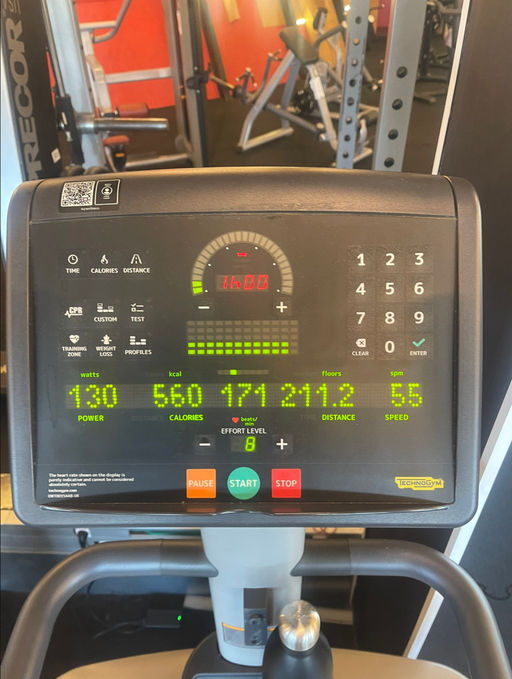
What if I didn’t manage to reach the goal of climbing and descending 100 floors within 35 minutes?
It’s not a big deal. The program is designed to push you to the edge of your abilities. All you need to do is stick to the “one day on, one day off” routine and you’ll be just fine, even if you don’t reach the 35-minute goal. Forty-five minutes is fine too, just keep in mind it will take you a bit longer to handle the climbs during the trek. However, if you see that you simply can’t reach the 35-minute target in any way, don’t push yourself to the extreme! What’s important is that you experience going up and down 100 floors with weight on your back and in jumps of two floors, at least once.
I don’t have 6 weeks! What should I do?
Do as much as you can and hope for the best. Honestly, any kind of training, even just two or three sessions, is better than doing nothing before a tough trek. I really don’t recommend taking on difficult treks (levels 4–5) without any preparation. Don't do it to yourself. Also note that some level 3 or higher treks only have one day at that difficulty level. It’s enough for just one day to be level 3 while the rest of the trek is level 1 or 2 for the entire trek to be rated level 3. If you’re worried that you’re not fit enough but still feel you absolutely have to do this trek (or your friends are already set on it), check whether there’s an easier alternative for that day, or “cheat” a little and skip that section, assuming you can rejoin the route later using public transport or another arrangement.
This is really hard! Maybe this isn't for me?
You’ll probably find yourself asking this question several times during the first week, “Why on earth am I doing this? Do I really need to do this stupid trek?” . The truth is, the beginning of this training is tough, exhausting, and frustrating. Chances are, if you’re out of shape, you’ll crash after 30–50 floors on the first day and feel pretty disappointed. But I have to tell you, even if you’re seriously out of shape, this training gets you fit really, really fast. Take your time on the first day, and you’ll see how after a week how much you've improved. If you’re generally healthy and stick with it, you’ll reach the 35-minute goal, or get very close to it, much faster than you think.
What if I missed a training day and didn’t work out for two days?
Really not a big deal but do try to stick as closely as possible to the "one day on, one day off" routine. Consistency is the secret to success. Even if you fail miserably in the first few days, if you keep at it and complete six weeks sticking as closely as possible to the one day on, one day off training schedule - you’ll be truly ready for tough treks. Physically, you won’t break. I promise you that.
Okay, I’m back from the trek and it was so much fun, and I love my new abilities. How do I keep them?
After 3–4 days on a challenging trek (level 3 or higher), you usually reach what’s called “trail legs,” a state where your body finds it much easier to handle long and sometimes grueling days, . Unfortunately, keeping those “trail legs” without doing a long and demanding hike every day is almost impossible. However, you can maintain a good alpine fitness level by doing stair workouts (even without carrying weight and by taking two steps at a time) at least twice a week.
OK, we’ve covered the climbing part, I’m not afraid anymore. But what about the monotonous walking?
On days when you do stair workouts, aim to walk at least 5,000 steps as well. That’s really not very much. On your “rest” days, try to walk a minimum of 10,000 steps, though 15,000 or more is highly recommended. That’s a little over 10 kilometres — and even if it’s mostly on asphalt, it’s still excellent preparation for trekking because it gets your body used to long periods of continuous movement.
Personally, I usually walk at least 15,000 steps on a normal day anyway, even if I’ve also done a stair workout. In the two weeks before a trek, I try to increase that to around 20,000–25,000 steps per day. At that point, you’re already simulating the effort of a full day on the trail.
Whenever possible, try not to walk only on completely flat terrain. Gentle climbs and descents are ideal, and dirt paths or trails are even better.
One interesting thing I’ve noticed is that carrying a heavy backpack is extremely useful for uphill training, but doesn’t necessarily improve endurance very much during regular step workouts. Surprisingly, ankle weights can actually be more effective for building trekking-specific strength and stamina.
In the end, if you consistently follow these two simple forms of training — stair climbing and long walks — you will be physically prepared for virtually any trek, even the most gruelling ones.
And remember: consistency is what matters most. Not motivation. Not intensity. Just showing up every other day for six weeks.
Good luck!