Switzerland

Tour des Muverans

Introduction
Switzerland’s best-kept secret.

A 55-kilometre trek through constantly shifting landscapes, moving from the grandeur of classic Swiss Alpine scenery to raw, rocky terrain that feels almost otherworldly, and then into lush green meadows dotted with grazing cattle.

The route is highly flexible, with multiple possible starting points and a wide range of accommodation options along the way. It can be completed comfortably in four days, extended into a full week for a more relaxed pace, or shortened to three days by experienced hikers. More advanced trekkers also have the option to include several significant peaks along the route.

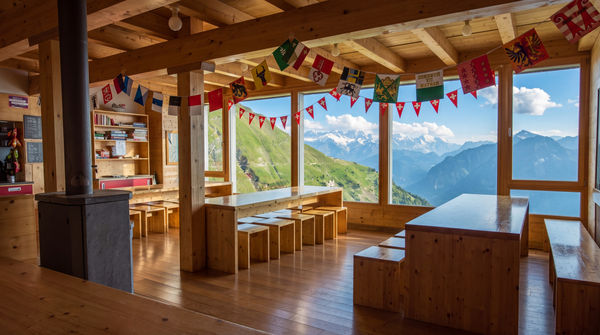
The mountain huts along the trail are a highlight in themselves. Each has its own character and atmosphere, and the food is notably high quality, as is typical in French-speaking Switzerland. One hut features a large panoramic window that frames a striking mountain view directly from the dining room. Another is known for its collection of musical instruments, including a piano transported by helicopter, where occasional live performances are held in the heart of the mountains.

Wildlife is present throughout the route, with frequent sightings of marmots, Alpine ibex, and birds of prey.

After completing the circuit around the dramatic peaks of the Muverans, you'll understand why this is known as a trek with soul and one of the most beloved among Swiss hikers. 
01·Day by day

4 hiking days

Tour des Muverans - 1
Day01
Pont de Nant → Lac de Derborence
Grade
3
Length
12.77 kmkm
Ascent
971 mm
Descent
754 mm
Time
05:00
The bus will drop you off in front of Auberge de Pont de Nant, near the trail information signs. Start walking north along the access road to the restaurant, then turn right (east) at the first junction. Immediately after the turn, the trail begins to climb up the steep valley between the Argentière ridge on your left and the higher ridge on your right, whose summit is Pointe de Paneirosse at 2,839 m. 

The path gradually rises along the right side of a stream, and the ascent becomes steeper as you enter a beautiful alpine forest of conifer trees. After almost two kilometres and a 295m climb, you will reach Le Richard hut, which usually operates in season as a small alpine café where you can buy drinks and snacks. 

Continue for about another kilometre up through the mountain pastures (called Alpage in French) until, after climbing about 220 m and crossing a small stream, you reach La Varre farm, which runs a small restaurant where you can stop for a light lunch and a drink. 

Keep walking through the lush valley, following the heart of the pasture, until you reach the mountain pass Col des Essets. From here, at 
2,029m, you can see the valley you ascended on one side and the Anzeidaz plateau on the other. Descend gently toward the Anzeidaz plateau, and after about a kilometre and a half you will reach two huts where you can eat and stay overnight: Cabane Barraud (an unmanned hut) and Refuge Giacomini (a staffed hut). 

Ahead of you to the north rises the vast and impressive Diablerets range, forming a massive wall of sedimentary rock that you will follow along until the descent to your overnight stop. 

The dominant peak of the range is Sommet des Diablerets at 3,209 m, behind which lie two large glaciers and two smaller ones. The high altitude means you are likely to see patches of snow on the peaks, especially if you are hiking early in the season. Continue along the trail that follows a small stream until you reach the mountain pass Pas de Cheville at 2,038 m. 

This is the highest point of today’s route, and from here begins a somewhat steep descent that will bring you back to the tree line along a beautiful path leading to your accommodation for the night, Refuge du Lac Derborence. If you still have some energy left, a walk around the lake is a wonderful way to end the day.
Tour des Muverans - 2
Day02
Lac de Derborence → Cabane Rambert
Grade
3
Length
11.37 kmkm
Ascent
1272 mm
Descent
175 mm
Time
05:16
Head south from the cabin. The day is dominated by a steady ascent, but the incline remains consistently gentle, with no steep or technical sections, making this a comfortable and accessible hiking stage.

About one kilometre from the lake, the trail enters a lightly wooded area and continues alongside a small stream flowing northeast toward the lake you left in the morning. On both sides of the valley, two prominent ridges rise sharply above the trail. The Paneirosse Ridge, which was on your right yesterday, remains on your right today, indicating you have effectively circled it. To your left stands the Perron Ridge, with Mont à Perron (2,667 m) as its highest visible summit.

These ridges, like the nearby Diablerets massif crossed the previous day, are composed of heavily eroded sedimentary cliff formations. Their layered structure and pale grey colouring create a distinctive “lunar” appearance. The landscape functions almost as an open geological section, where the stratification of rock is clearly visible and the immense forces that shaped the Alps can be directly observed.

After approximately three kilometres of walking (around one and a half hours) through the valley, you reach the Gîte d’alpage de Dorbon, a mountain guesthouse with a distinctive character. It serves as an alternative overnight option to the Derborence Hut in case of full occupancy.

The family running the gîte has a strong connection to music, and on some evenings live performances take place in the dining room during dinner. For those who play instruments, the hut is particularly welcoming, with a piano (transported by helicopter) and a selection of instruments including guitars, violin, and accordion. For passing hikers, it is also an excellent place to stop for brunch or a drink. (Cash only.)

From Dorbon, continue along the trail as it climbs gently toward a small grove crossed by the La Derbonne stream. After leaving the trees, a prominent cliff appears on your right, its layered structure clearly exposed. The terrain then opens into a markedly different alpine environment: green meadows give way to steep, mineral-coloured slopes in tones of grey and taupe.

Lakes such as Lac de la Forcla appear in striking blue-green shades, often shifting toward indigo depending on light conditions. At around 2,460 metres, early in the season it is common for parts of the lake to remain frozen or contain floating fragments of ice, enhancing the stark alpine character of the area.

A final, slightly steeper ascent leads to the Col de la Forcla at 2,541 metres. From the pass, there are wide views toward the valley where the town of Sion lies, partially hidden behind the Cry Ridge to the left.

The trail then descends slightly before continuing along a balcony path that traverses a broad scree slope beneath the ridge connecting Tête aux Veillon (2,846 m) and Grand Muveran (3,051 m), the highest peak in the area. At the base of this slope lies Cabane Rambert, your accommodation for the night. A short but moderately steep final climb leads directly to the terrace, which overlooks the valley below.

From the hut, it is also possible to continue toward the summit of Grand Muveran, which lies approximately 469 metres higher. The ascent requires no technical equipment under normal conditions, though it should only be undertaken in suitable weather and with adequate preparation.


Tour des Muverans - 3
Day03
Cabane Rambert → Cabane Demècre
Grade
3
Length
13.19 kmkm
Ascent
885 mm
Descent
1093 mm
Time
04:56
Begin the day by descending the winding access trail you climbed yesterday to reach Cabane de Rambert, returning to the trail junction below. From there, continue downhill to the right, heading south and then west for about one kilometer and losing roughly 200 meters in elevation. As you descend the moderately steep slope toward the valley, the lively flow of the Salentse stream accompanies you along the way. Below, the village of Avornaz comes into view, spread across the broad valley floor. Ahead and to the right, the towering peaks of the Mont Blanc Massif dominate the horizon above the surrounding mountains.

Continue descending for another two kilometers, dropping an additional 364 meters in elevation. Near the end of this section, the trail steepens considerably, zigzagging sharply downhill before the stream finally parts from your route. You then join a beautiful balcony trail crossing three scree slopes that spill down from the ridge above. This exposed section remains completely level, following a single contour line and allowing for fast progress, though care is advised along the narrow traverse.

After approximately two more kilometers with almost no change in elevation, you arrive at the mountain restaurant Jorasse at 1,946 meters. From here, an easy cable car connection leads down to the village of Ovronnaz, making this one of the convenient access points along the route. By this stage, you will already have completed roughly one-third of today’s hike. It is an excellent place to stop for brunch or coffee and enjoy the sweeping valley views before turning away from them for the remainder of the day. On fine days, when the cable car is operating, the kitchen serves hot meals beginning at 11:30.

From the restaurant, continue west along a gently ascending trail that climbs about 80 meters over one kilometer through forested sections and beneath rocky cliff walls until reaching the Petit Pré farm. Ahead rise two striking peaks: to the right stands Dent Favre at 2,917 meters, alongside its slightly lower neighboring summit, Tête Noire at 2,871 meters.

This marks the main ascent of the day: a climb of 450 meters over 3.5 kilometers along a beautiful and dramatic trail that rises steadily, though steeply, above green alpine meadows before briefly reentering the barren, moon-like landscape beneath Fenestral Pass at 2,452 meters. Directly on the pass stands Cabane du Fénestral, where overnight accommodation is available for those wishing to shorten the stage.

The true reward for this demanding climb is the breathtaking panorama overlooking Lac Supérieur de Fully, with the peaks of the Mont Blanc Massif stretching across the horizon beyond. This is one of the highlights of the entire trek. The scenery here is exceptional, and even if you are not spending the night at the hut, it is well worth pausing for a drink on the terrace and taking in the view.

Descending along the trail toward the lake’s western shore, you cross grassy alpine slopes inhabited by numerous marmots. Whether or not you stopped at Cabane du Fénestral, it is worth resting for a few moments beside the lake on the soft alpine grass before beginning the final short climb of the day toward Cabane Demècre, beautifully situated in the mountain pass of the same name at an elevation of 2,361 meters.


Tour des Muverans - 4
Day04
Cabane Demècre → Pont de Nant
Grade
3
Length
17.58 kmkm
Ascent
1065 mm
Descent
2171 mm
Time
06:21
Head west from the mountain pass and descend approximately 200 meters along a wide, zigzagging trail that stretches for about one kilometer down to the meadow below. From there, the route continues for roughly another kilometer with little change in elevation. Beyond this point, the trail follows a magnificent balcony traverse for the next five kilometers, just above the tree line, winding between green alpine slopes and gray rocky peaks as you make your way north toward Lake Geneva. On clear days, its eastern edge is easily visible in the distance.

To your left, the entire Dents du Midi massif unfolds in dramatic fashion, with its chain of summits, most of them rising above 3,000 meters. This balcony trail, approximately 5.5 kilometers long, climbs gradually toward La Tourche Hut, though the width and character of the path vary considerably along the way. In several sections, chains and steel cables fixed to the rock assist with safe passage across the more exposed terrain. Sturdy gloves are recommended for a more secure grip.

Take time to pause at La Tourche Hut (2,198 meters), either on the terrace or inside the dining room, which is considered one of the highlights of the route thanks to its vast panoramic window overlooking the dramatic drop below, the broad valley beyond, and the iconic peak of Cime de l'Est (3,170 meters), one of the most striking summits in the Dents du Midi range.

After your break, continue toward the day’s main ascent, leading to the highest point of the entire trek: Pointe des Martinets at 2,650 meters. Be aware that sections of the climb can be steep and slippery in wet conditions, requiring extra caution. It is also important to remain on the official red-and-white marked trail and avoid the extremely dangerous shortcut through Col des Perris Blancs, where the unstable terrain is highly prone to rockfall and is not part of the designated route.

From the summit of Pointe des Martinets, descend carefully to Col des Martinets at 2,615 meters. From here begins a long descent, first crossing an impressive ancient glacial cirque where, at its southern edge, remnants of the glacier that once completely filled the basin can still be seen. This section continues for about two kilometers before the trail enters the beautiful, wild, and forested Nant Valley. With Grand Muveran towering to your right, continue for another 5.5 kilometers until you finally return to Pont de Nant Inn, the point where your trek began.


02·Map room

Route map & GPX files

Download GPX
03·FAQ

Before you set out

How to get there?

Everything you need to get from the city with the closest international airport to the start of the trek.

From Geneva’s main train station, take the RE33 train toward St Maurice and get off after about 1 hour and 30 minutes in Bex. From Place de la Gare in Bex, take bus line 152, which will bring you in about 30 minutes to the Plans-sur-Bex - Pont de Nant stop.
How to get back?

Everything you need to know to get back from the trek's end point to the city you came from.

From the Pont de Nant station (Plans-sur-Bex - Pont de Nant), take bus line 152, which will bring you back to Bex in about 32 minutes. From there, take the RE33 train line back to Geneva, a journey of approximately 1 hour and 33 minutes. Note that buses from Pont de Nant, the starting and ending point of the trek, are not frequent. There is one in the morning (07:39), one at midday (12:42), and two in the afternoon (16:42 and 17:42). You can walk from the inn to Bex or ask the inn to arrange a taxi if you miss the next bus.
Where to sleep?

A hotel room, refuge, or tent? All the options for this hike including tips, guidelines, and a summary of local rules around bivouacking.

Camping along this route is extremely limited to nearly impossible, both due to the rugged terrain and regulations within the nature reserve. Instead, the itinerary is designed around a network of well-situated mountain huts, each with its own character and atmosphere, and a wide range of options along the way.

Booking accommodation in advance is strongly recommended, particularly for the smaller huts, where availability can be limited in peak season. All huts and reservation details are available through the accommodation planning system.

For hikers wishing to split the route into additional days and reduce daily distances, the following options are suggested:

5 hiking days:
Day 01 (5:00 hours) Pont de Nant ← Lac de Derborence
Day 02 (5:15 hours) Lac de Derborence ← Cabane Rambert
Day 03 (3:40 hours) Cabane Rambert ← Cabane du Fénestral
Day 04 (3:45 hours) Cabane du Fénestral ← La Tourche
Day 05 (4:15 hours) La Tourche ← Pont de Nant

6 hiking days:
Day 01 (3:15 hours) Pont de Nant ← Refuge Giacomini
Day 02 (3:15 hours) Refuge Giacomini ← Gîte Dorbon
Day 03 (3:30 hours) Gîte Dorbon ← Cabane Rambert
Day 04 (3:40 hours) Cabane Rambert ← Cabane du Fénestral
Day 05 (3:45 hours) Cabane du Fénestral ← La Tourche
Day 06 (4:15 hours) La Tourche ← Pont de Nant

Good to know:

Important info, enrichment details about the hike, interesting anecdotes, recommendations, food, culture, and more to make your trip more successful.

From the Martinets mountain pass, the landscape opens dramatically into the wild Nant Valley, with the Argentine ridge and the Diablerets massif rising in the background. This viewpoint is widely regarded as one of the most striking in Switzerland, offering a clear sense of scale and contrast between the valley below and the surrounding peaks.

There is no need to carry large amounts of food or drinks on this route, as supplies can easily be obtained along the way in restaurants and mountain huts. It is nevertheless advisable to carry a water filter, allowing you to safely use natural water sources such as streams and lakes when needed, without relying on bottled water.

Swiss mountain huts are not typically inexpensive, but they are known for their consistently high standards. The food is of excellent quality, and the accommodation is generally comfortable, most often in dormitory-style rooms that offer a higher level of privacy and comfort compared to many huts in other alpine regions.