France

Around Fyz

Introduction
Far from the crowds around Mont Blanc, yet close enough to enjoy sweeping views of Western Europe’s highest peak, the Plateau de Praz-de-Fort unfolds like a vast natural balcony above the Alps.

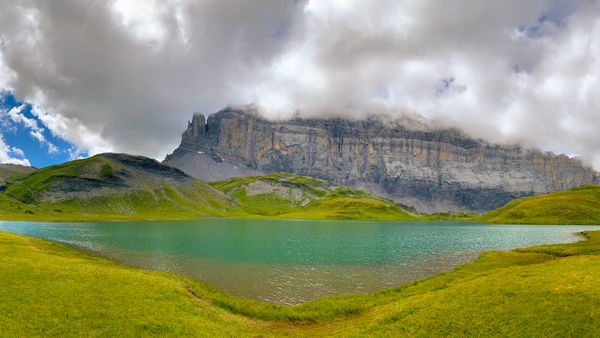
At its heart rises the immense wall of the Fiz range, whose weathered summits drift in and out of the clouds in an ever-changing spectacle. Quiet, elegant and deeply atmospheric, this is a trek of crystal lakes, rushing waterfalls and some of the most beautiful scenery in the French Alps.

Despite the dramatic landscapes, the route remains surprisingly accessible: even the longest day barely exceeds a moderate level 3 difficulty. It is therefore ideal for families with hiking experience and children comfortable with heights (recommended minimum age: 10).

Just 90 minutes by bus from Geneva — or around three and a half hours by car from Milan — you are transported into a world of wild alpine solitude on a little-known five-day circuit that still feels almost secret.

Along the trail, six charming mountain huts — often with surprisingly good availability — allow complete flexibility: tackle the route in three or four sporty days, or stretch it into six slow, unforgettable days among clouds, waterfalls and high mountain silence.

01·Day by day

5 hiking days

Around Fyz - 1
Day01
Le Lignon → (Refuge des Fonts)
Grade
2
Length
4.72 kmkm
Ascent
392 mm
Descent
198 mm
Time
01:55
The first day is intentionally relatively short, allowing you to reach the starting point comfortably. From the Le Lignon bus stop, walk down the winding road until you reach a signpost with yellow markers indicating a path that cuts across the bends of the D429 road and continues downhill. The trail is marked in red and white (GR96).

Follow it for about one kilometer, descending roughly 120 meters while carefully crossing the road several times as the path winds through forest and meadow. The GR96 then continues left (north) toward the village of Les Fardelays near the valley floor. Do not follow it. Instead, continue toward the Parking des Fardelays, where another signpost with yellow markers points east toward Refuge des Fonts.

From here, continue for about half a kilometer downhill through the forest until you reach the Pont des Fonts bridge spanning the rushing waters of the Giffres des Fonts River. Cross the bridge and begin a gentle climb of around 100 meters in elevation over roughly 600 meters until you arrive at Chalet de la Célière.

The route then follows a gradual ascent along the floor of the narrow and deeply carved Fonts Valley for about two kilometers on a wide dirt track, surrounded by dense forest and accompanied by the constant roar of the river to your right. After roughly two kilometers through the woods, you will reach another bridge crossing a tributary of the Giffres, with a small waterfall visible to your left.

Cross the bridge high above the turbulent waters and begin the final ascent toward a cluster of small mountain cabins, at the far end of which stands Refuge des Fonts, your lodging for the night.
Day02
(Refuge des Fonts) → (Refuge d'Anterne Alfred Wills)
Grade
2
Length
5.96 kmkm
Ascent
688 mm
Descent
253 mm
Time
02:48
Leave the cabin heading south and begin a gentle climb along a forested trail. After about half a kilometer, you will reach the Mitaines Bridge (Pont de Mitaines), which crosses the Ravin des Chaux stream. Take care while crossing the narrow concrete bridge, especially with young children, as there is no fence or railing.

Beyond the bridge, continue ascending along a beautiful woodland path that winds upward in zigzags for about 1.5 kilometers, gaining 269 meters in elevation. As the forest begins to open, you will notice a bare mountain slope on your left and, for the first time, the impressive Fiz ridge rising ahead of you.

At its northern end stands Pointe de Sales (2,497 m), followed further south by Pointe de Chardonière (2,723 m), and finally the highest summit of the ridge, Tête à l'Âne (2,804 m). Owing to local microclimate effects, the ridge is often wrapped in fast-moving clouds, lending its weathered peaks a dramatic and mysterious atmosphere.

From here, continue on a steeper ascent, gaining a total of 355 meters over 2.25 kilometers, until you reach the Petit Col d’Anterne mountain pass at 2,030 meters. A magnificent panorama opens up from the pass: a vast green meadow stretching toward the base of the towering Fiz ridge.

Descend along the trail toward the valley floor, gradually drawing closer to the Anterne stream, until you reach a small cluster of huts. Those who have reserved accommodation in advance can spend the night here.

If you are camping, continue approximately 2 kilometers further south to the beautiful Lac d’Anterne. To the east of the lake, you will find many excellent spots for overnight camping (permitted between 19:00 and 09:00 the following morning, for one night only). Lighting fires and swimming in the lake are prohibited.


Around Fyz - 3
Day03
(Refuge d'Anterne Alfred Wills) → (Refuge Le Châtelet d'Ayères)
Grade
2
Length
10.17 kmkm
Ascent
569 mm
Descent
959 mm
Time
03:35
If you did not camp on the shores of Lac d’Anterne, leave the hut and head south, then east along the trail crossing the meadow and climbing 269 meters to the plateau over a little more than one kilometer. On your left, you will notice a small hut used as an emergency shelter during winter.

Continue on a very gentle ascent of around 40 meters over roughly half a kilometer until you reach a junction of several small trails. Before you lies Lac d’Anterne, the largest lake in the area. Although its waters may look inviting, especially on a warm day, swimming is prohibited in order to preserve the delicate ecological balance of the protected nature reserve through which you are hiking.

The trail branching to the right circles the lake from the west, while the path continuing straight ahead leads toward the start of the ascent to the mountain pass after a little more than a kilometer of walking along the lakeshore. The climb to Col d’Anterne follows a beautiful trail that is never particularly steep, gaining 171 meters over just over one kilometer. As you approach the summit, marked by a large cross, be sure to put on your windbreaker, as the wind at the pass is often cold and powerful.

The view from the top is breathtaking. To your right rises the summit of Pointe d’Anterne at 2,733 meters, while directly ahead stands the vast snow-covered dome of Mont Blanc in all its glory. This is one of the true highlights of the trek and among its most spectacular viewpoints.

Descend from the pass along a moderately steep path that zigzags for 1.2 kilometers beside the Souay stream (Le Souay), dropping 252 meters until you reach the Moëde hut. Here you can refill your water bottles and/or stop for a short break or light meal.

From this point, the trail descends gently for about half a kilometer, first along a wide path that gradually narrows until reaching Col du Laouchet. On your left, you can spot the small Lac de Laouchet. Continue another kilometer south along a pleasant and easy trail until you arrive at the much larger Lac de Pormenaz, distinguished by the small island at its center. Swimming is prohibited here as well.

Follow the western shore of the lake for approximately one and a half kilometers until you reach a slightly steeper section known as La Chorde. Here you will encounter four ladders and several sections equipped with railings and/or chains, along with additional via ferrata-style aids fixed into the rock to assist in negotiating the short cliff passages. The descent is not particularly technical and should not pose difficulty even for hikers with a mild fear of heights.

The steep descent of 315 meters ends once again at the Souay stream (Le Souay) and two additional streams plunging sharply down from the right (west). Pass the Souay hut and continue along a wide and highly scenic forest dirt road until you reach the hut in the Le Châtelet area, your accommodation for the night.

Note: if you are hiking with a tent, wild camping is not permitted here. Most hikers camp either near Lac de Pormenaz, which you passed earlier, or after descending La Chorde near the Souay hut. Another option is to continue approximately two more kilometers along the trail (see the following day’s description) to the designated campsite at Passy Plaine Joux.


Around Fyz - 4
Day04
(Refuge Le Châtelet d'Ayères) → (Refuge de Platé)
Grade
3
Length
7.90 kmkm
Ascent
978 mm
Descent
362 mm
Time
03:51
This is not the longest day on the trail, but it is certainly one of the most challenging — and among the most beautiful. Begin walking southwest along the continuation of the scenic forest path, while the Mont Blanc massif plays hide-and-seek through the trees to your left.

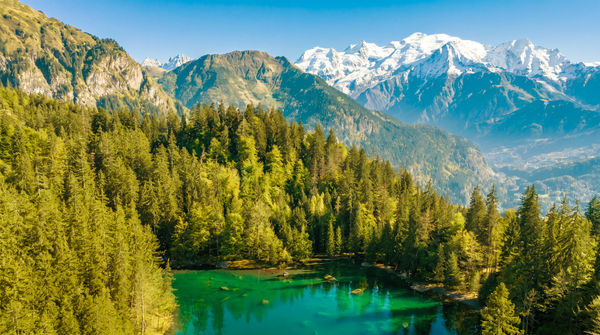
After about one kilometer of gentle walking along the same contour line, you will arrive at one of the most beautiful lakes in the world: Lac Vert. Its waters are crystal clear, allowing you to see straight to the bottom, which gives the lake its remarkable turquoise-green color and its name. This is one of the iconic sights of the French Alps.

As you begin circling the lake from the north, you will reach a small clearing offering a perfect viewpoint: the lake below, framed by the snow-covered Mont Blanc range in the background. Just beyond the clearing, a small path branches left and descends toward the water. It is highly recommended to take this detour, walk around the lake, and enjoy the rare tranquility of the area. It is also an ideal place for forest bathing or a picnic brunch on the nearby benches. A small restaurant can also be found close to the lake.

Continue easily along the wide forest path for another kilometer until you pass the large campsite of Passy Plaine-Joux (Aire naturelle de camping de Passy Plaine-Joux). Here you will find two restaurants, a large parking area, a bus stop, and a paragliding launch point. Take note: this is an excellent place to refill your water bottles, especially on a hot day, as you may not encounter reliable water sources again until reaching your accommodation at the top of the climb.

Continue another kilometer through the forest, passing the tennis courts of Guebrian. There is also a bus stop here serving the towns and villages in the valley below. One more kilometer through the woods brings you to the base of the day’s main ascent.

Here the trail turns sharply north, still within the forest, and climbs gently for about 140 meters over one kilometer until reaching the stream of L'Ugine. From this point onward, the path begins a steep ascent in short zigzags through the forest. Climb approximately 135 meters over half a kilometer until you meet the stream once again.

At an altitude of 1,600 meters, the forest finally falls away, revealing a steep and fully exposed climb of 610 meters over 2 kilometers leading to your accommodation near the Chalets de Platé. Be aware that this is a demanding and somewhat technical ascent, with sections that may feel dizzying for hikers uncomfortable with heights. However, the trail is very well maintained, equipped with chains, ladder rungs, and small metal bridges to assist you through the climb toward the Platé plateau and the final narrow, steep section known as the “Cheminée de Platée.”

This is an impressive and exhilarating stretch of trail, culminating in a breathtaking panorama over the Passy Valley with the towering Mont Blanc massif rising beyond it.

The Platé plateau, also known as the “Desert of Platé,” is a truly unique and fascinating landscape. Here you will walk across gray limestone formations known as “lapiaz,” sculpted over time by flowing water into deep grooves and intricate patterns, sometimes dotted with alpine vegetation growing between the rocks.

From the viewpoint, only 200 meters remain to reach your accommodation. There is no accessible natural water source here, but bottled water can be purchased at the hut.


Around Fyz - 5
Day05
(Refuge de Platé) → Le Lignon
Grade
2
Length
10.15 kmkm
Ascent
342 mm
Descent
1196 mm
Time
03:07
Attention! Along the first 5.5 kilometers of today’s route, there are no water sources. Be sure to stock up on water before setting out; bottled water can be purchased at the hut.

Head east from the hut and begin the ascent toward Col de la Portette. This is the only climb of the day, gaining approximately 300 meters in elevation. The slope gradually steepens as you approach the pass, with the trail zigzagging upward through striking and unusual rock formations, though without any particular technical difficulty.

From the pass, the gentler eastern side of the Fiz range comes into view ahead of you. Descend from the pass in zigzags and continue for about one kilometer along a gentle slope across the rocky Lapiaz plateau. Then turn right (east) and continue for another kilometer, descending approximately 200 meters until you reach the valley of Le Grand Pré.

Follow the valley for about two kilometers until you arrive at a small cluster of huts known as Selles. This is a good place to stop for a light meal, refill your water bottles, and rest before continuing north along the trail. About 200 meters farther on, you will notice a small chapel on your right. Pass it and continue descending into a narrow and deeply carved valley beside the Sales stream, where the woodland becomes increasingly dense on your right-hand side.

After about 800 meters, you will reach the Cascade de Trainant. Another half kilometer of easy descent alongside the stream brings you to additional waterfalls, the Cascade de Sales. Continue for another kilometer and a half along a trail that becomes progressively more forested until you reach the spectacular Cascade de la Pleureuse and Cascade de la Sauffaz.

The Pleureuse Falls are among the most beautiful in the region. Their name, “Pleureuse” — meaning “the weeping one” — comes from their resemblance to tears streaming down the cheeks of a young woman.

From here, only a final descent of 240 meters over 1.2 kilometers remains before reaching the end of your journey at the Le Lignon bus stop. Take note: the last bus to Sixt-Fer-à-Cheval departs at 17:50 (see logistics page for details).


02·Map room

Route map & GPX files

Download GPX
03·FAQ

Before you set out

How to get there?

Everything you need to get from the city with the closest international airport to the start of the trek.

From the central bus station of Geneva (Gare Routière Genève), take bus line Y02 operated by Cars Région Haute-Savoie, which will bring you to the central station of Sixt-Fer-à-Cheval in about 1 hour and 20 minutes. 

From there, take line 6, which will get you to your starting point, the Le Lignon bus stop, in about 20 minutes. Line 6 runs daily at 07:47, 08:35, 09:15, 11:30, 14:15, 15:05, 16:05, and the last departure is at 17:05.
How to get back?

Everything you need to know to get back from the trek's end point to the city you came from.

From the Le Lignon bus stop, which marks the end point of the trek, take line 6 back to the main station of Sixt-Fer-à-Cheval, a 20-minute ride. 

The bus runs daily at 08:10, 08:55, 09:35, 10:45, 12:15, 14:40, 15:40, 16:30, and the last one at 17:50. [It is also fairly easy to catch a ride from the parking area back to the village of Sixt.] 

From the main station in Sixt, take bus line Y02 of Cars Région Haute-Savoie to the main bus station in Geneva (Gare Routière Genève), a journey of about 1 hour and 20 minutes.
Where to sleep?

A hotel room, refuge, or tent? All the options for this hike including tips, guidelines, and a summary of local rules around bivouacking.

Wild camping is allowed along this route except around Lac Vert and near Châtelet. If you set up a tent, you may stay in the same spot for only one night. The tent must be pitched after 7:00 p.m. and taken down before 9:00 a.m. the next morning, otherwise you risk a fine and confiscation of the tent by rangers.

Lighting fires is prohibited anywhere along the route, but you may carefully use a camping stove for cooking. Dogs are not allowed on any part of the trail.
Good to know:

Important info, enrichment details about the hike, interesting anecdotes, recommendations, food, culture, and more to make your trip more successful.

Swimming in the lakes along the route is prohibited in order to preserve the delicate ecological balance of the Passy Nature Reserve. Lighting fires is also forbidden. No dogs of any kind are allowed on the trail, even if kept on a leash. 

 Please note, on the last day at the Platé plateau there are no water sources for the first five kilometers. Make sure to carry enough water before leaving the accommodation point on the fourth day.