Italy

The Path of the Gods (Extended)

Introduction
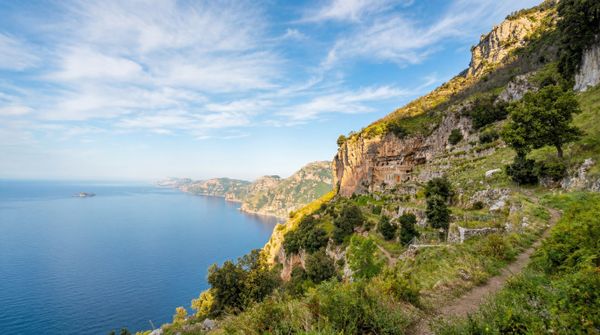
This is no ordinary trek. It follows one of the most beautiful coastlines in the world, climbing and descending the steep mountainsides of the Amalfi Coast as they plunge into the Mediterranean below.

One of the highlights of the route comes on the third day, along a spectacular section known as the Sentiero degli Dei, the “Path of the Gods.” Perhaps it earned its name because it traverses landscapes that seem almost unreal, high above the sea, with lemon, olive, and laurel trees lining the trail and filling the air with their fragrance in spring and early summer.

This is Italy at its finest. Colourful villages cling improbably to steep mountainsides above turquoise water, while ancient paths connect hidden valleys, cliffside gardens, and historic settlements. Along the way you will encounter impressive archaeological sites, beautifully maintained villa gardens perched above the sea, and, of course, some of the finest food in Italy, often enjoyed in a piazza overlooking the Mediterranean.

The route is not an easy one. There are plenty of climbs and descents, and some days can be demanding. The rewards, however, are enormous.

And if you're not quite in peak hiking condition, don't be intimidated by the difficulty. This is one of the few long-distance treks where it is easy to "cheat" a little. Public transportation is excellent, and ferries can be used to bypass some of the tougher sections. Alternatively, you can simply add a few extra days to the itinerary and spend them relaxing in one of the many picturesque villages along the way.

01·Day by day

6 hiking days

The Path of the Gods (Extended) - 1
Day01
Raito → Maiori
Grade
3
Length
11 kmkm
Ascent
989 mm
Descent
1150 mm
Time
05:20
Standing with your back to the church, look toward the fountain on the north side of the road. To its right is a small tobacco shop, and beside it a staircase marking the start of the trail.

Climb the steps and begin the day's ascent. Over the next 6 kilometres, the route gains elevation with sections of varying steepness, passing through woodland and following a ridge with magnificent views over the Gulf of Salerno.

Just before the trail begins its descent back toward the coast, you will reach the Sanctuary of Maria Santissima Avvocata, which is open to visitors. The sanctuary is an important Catholic pilgrimage site and attracts large numbers of worshippers during Easter week.

From here, descend approximately 4 kilometres along a network of stone steps winding through terraced lemon and olive groves. Many of the terraces are shaded by beautiful traditional wooden pergolas, some draped with grapevines, creating one of the most characteristic landscapes of the Amalfi Coast.

By the end of the day, you will arrive in the town of Maiori. Above the beach, the small harbour, and the turquoise waters of the bay rises Mezzacapo Castle, one of the town's most recognisable landmarks. Maiori offers a wide range of accommodation options, as well as numerous restaurants along the seafront.
The Path of the Gods (Extended) - 2
Day02
Maiori → San Lazzaro
Grade
4
Length
14.3 kmkm
Ascent
1532 mm
Descent
902 mm
Time
05:25
Follow the narrow Via Scala Santa, which runs south of the Mazzacapo Gardens, and begin climbing the steps north of the Basilica of Santa Maria a Mare. As soon as the last houses of Maiori fall behind you, the route enters one of the Amalfi Coast's most beautiful historic paths: the Via dei Limoni, or "Lemon Path."

Over the next 2 kilometres, the trail winds through terraces of lemon groves and connects Maiori with the neighbouring village of Minori. This is an ideal place to stop for a coffee by the sea before continuing the climb.

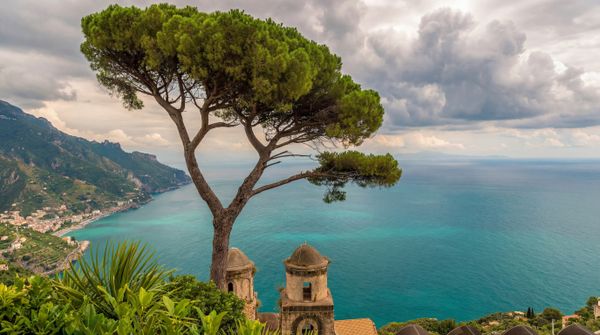
From Minori, a steep ascent of stone steps gains height rapidly. After about a kilometre, you will reach the Church of Santa Maria delle Grazie a Paradiso. Continue uphill and you will soon arrive at one of the highlights of the entire trek: Villa Rufolo, one of the true gems of the Amalfi Coast. For 8 euros, you can visit the villa, the gardens, or both. It is highly recommended, not only for its history and architecture but also for some of the finest views and photographs on the route.

Farther along, you will pass Villa Cimbrone, another remarkable estate that is open to visitors. Its gardens and terraces offer breathtaking views across the coastline, the bay, and the mountains beyond.

From Villa Cimbrone, follow Via Petrito as it descends back toward the sea and the picturesque village of Atrani. There are several restaurants here, as well as a small grocery store if you wish to stop for lunch.

If you do, save room for dessert. Rather than ordering it in Atrani, follow the beautiful panoramic path that connects Atrani and Amalfi. Once in Amalfi, treat yourself to a refreshing lemon sorbet from one of the many gelato shops around Piazza Duomo. The best place to enjoy it is on the broad staircase leading up to the town's magnificent cathedral, which is also well worth a visit.

From Amalfi, the route continues with another ascent of approximately 7.8 kilometres toward San Lazzaro. The village is considerably quieter and less expensive than heavily visited Amalfi, making it a pleasant place to spend the night.

And if, by this stage of the day, you are not particularly enthusiastic about another long climb through forest and along the cliffs above the coast, this is one of those places where it is perfectly acceptable to cheat a little. Regular buses connect Amalfi and San Lazzaro via a much shorter, though considerably less scenic, route.

The Path of the Gods (Extended) - 3
Day03
San Lazzaro → Positano
Grade
3
Length
13.7 kmkm
Ascent
1239 mm
Descent
1861 mm
Time
05:48
From San Lazzaro, follow the small path climbing toward the Schiato waterfalls and take the upper trail leading to Bomerano. The route passes through beautiful countryside and includes a few short sections that can feel slightly technical.

Bomerano is a good place to take a break, with plenty of shops, cafés, and restaurants in the village centre. Beyond the village, you will join one of the most famous walking routes in Italy: the Sentiero degli Dei, or "Path of the Gods."

There is a reason this trail has become so well known. For much of the route, it hangs high above the coastline, offering breathtaking views of the Amalfi Coast and the Mediterranean far below. Even by the standards of this trek, it is a particularly memorable section.

At the end of the trail, you will arrive in Nocelle, where several restaurants make excellent lunch stops. In the small square in front of the Church of the Holy Cross, you will also find a popular stand serving freshly squeezed citrus juices. It is well worth stopping here for a drink while taking in the impressive view of the ridge descending steeply toward the sea.

From Nocelle, continue along a beautiful cliffside path. Although the trail is well paved, some sections may feel challenging for those uncomfortable with heights. The route eventually leads all the way down to Positano, perhaps the most famous town on the Amalfi Coast.

Among its many claims to fame, Positano served as a filming location for the series Ripley. With its colourful houses tumbling down the mountainside toward the sea, it is an unforgettable place to end the day and spend the night.

The Path of the Gods (Extended) - 4
Day04
Positano → Colli di Fontanelle
Grade
3
Length
11.6 kmkm
Ascent
1184 mm
Descent
879 mm
Time
05:18
The climb out of Positano is steep and can feel surprisingly demanding, so it is worth preparing yourself mentally before setting off. The good news is that the effort is more than rewarded by the views.

After approximately 5 kilometres of climbing, you will reach the summit of Monte Comune. From here, one of the most impressive panoramas of the trek unfolds before you, with the mountains dropping dramatically into the Bay of Positano below.

For the first time on the route, you can also see your final destination: the resort town of Sorrento, perched on the cliffs across the peninsula on the far side of the cape. On clear days, the view extends even farther north to Mount Vesuvius and the outline of Naples beyond.

This is one of those places where it is worth taking a longer break, not only to recover from the climb but also to enjoy one of the finest viewpoints on the entire trek.

From Monte Comune, the route becomes much easier. The trail descends gently through magnificent scenery toward the pass of Colli di Fontanelle.

Around the small village you will find several options for accommodation, restaurants, and basic supplies. If nothing appeals, don't hesitate to take a short bus or taxi ride to one of the neighbouring villages, where there are plenty of additional places to stay and eat.

The Path of the Gods (Extended) - 5
Day05
Colli di Fontanelle → Termini
Grade
2
Length
10.7 kmkm
Ascent
578 mm
Descent
581 mm
Time
03:35
This is a short and relatively easy day, spent mostly away from towns and villages. One practical point to keep in mind is that there are no opportunities to buy food or water until you reach the minimarket in Torca, approximately 4.5 kilometres from the start of the trail, so make sure you have everything you need before setting out.

The path at the beginning of the day is slightly less maintained and not always as clearly marked as the previous stages. Pay attention to the route and watch your footing, particularly on rougher sections.

As on most mornings of this trek, the day begins with a climb, this time gaining about 100 metres over the first 2 kilometres. The effort is quickly rewarded with superb views before the trail begins a somewhat steeper descent along the cliffs overlooking the Mediterranean.

Throughout this section, you will enjoy magnificent views of the Li Galli Islands and the island of Capri. The scenery is among the finest on the trek and changes constantly as the trail follows the contours of the coastline.

Because the stage is relatively short, hikers arriving in Termini early enough may wish to continue on the popular circular walk to Punta Campanella. This beautiful excursion offers some of the best views of Capri and follows mostly well-maintained paths through a landscape of olive groves, citrus orchards, and small farms.

Termini, your destination for the night, offers several accommodation options as well as a number of restaurants where you can enjoy a relaxed final evening on the peninsula.

The Path of the Gods (Extended) - 6
Day06
Termini → Sorrento
Grade
2
Length
16 kmkm
Ascent
677 mm
Descent
937 mm
Time
04:20
If you did not visit Punta Campanella the previous day, begin the morning by following the circular trail to this scenic promontory. After completing the loop, continue toward the area of Massa Lubrense, a region known throughout Italy for its citrus fruits.

The route passes through a series of small villages, as well as countless cafés and restaurants, before gradually approaching the final destination of the trek: Sorrento.

Perched dramatically on high cliffs above the Mediterranean, Sorrento is one of the most famous resort towns in southern Italy and a fitting place to end the journey. Take some time to wander through the narrow streets of the old town, enjoy one last Italian coffee, or simply sit and watch the boats crossing the bay below.

If time permits, a short ferry ride will take you to the celebrated island of Capri, one of the most beautiful destinations in the region.

And if, after completing the trek, you still have some energy left, the adventure does not have to end here. The following days can easily be devoted to climbing Mount Vesuvius, visiting the remarkable ruins of Pompeii, or, ideally, both.

02·Map room

Route map & GPX files

Download GPX
03·FAQ

Before you set out

How to get there?

Everything you need to get from the city with the closest international airport to the start of the trek.

From Naples train station, take a train to Salerno, a journey of approximately 39 minutes. From Salerno station, walk about 10 minutes to the bus stop at Piazza XXIV Maggio and board bus number 1 toward Raito.

Ask the driver to let you off at the stop opposite the Chiesa di Santa Maria delle Grazie. It is important to mention this in advance, as the bus only stops there if passengers request it or if someone is waiting. The stop itself is easy to miss, marked only by a small sign beside the church.

Once you arrive, walk to the fountain in front of the church. The trek begins on the staircase immediately behind it.
How to get back?

Everything you need to know to get back from the trek's end point to the city you came from.

From Sorrento train station, take the Campania Express back to Naples. The journey takes approximately 1 hour and 14 minutes.

An even more enjoyable option is to return by ferry from the port of Sorrento. The crossing takes only about 45 minutes and passes via the famous island of Capri, which is well worth visiting if you have the time. From Capri, the ferry continues on to the port of Naples, making for a far more scenic journey than the train.
Where to sleep?

A hotel room, refuge, or tent? All the options for this hike including tips, guidelines, and a summary of local rules around bivouacking.

There are no suitable places to pitch a tent along this route, so wild camping is not really an option. Accommodation choices along the entire trail are plentiful and varied, but keep in mind that you will need to book in advance, especially during peak season (May–June and September). 

Note that many of the lodging options in this fairly touristy area are upscale, and quite a few are closed outside the main tourist season (that is, before April and after October).

Do not hesitate to use public transportation or taxis, as you will always be close to towns and villages along the route. You can also stay in one place for more than one night and use public transport to reach the trail and return.
Good to know:

Important info, enrichment details about the hike, interesting anecdotes, recommendations, food, culture, and more to make your trip more successful.

The Mezzacapo Castle, which you will see at the end of the first day on the edge of the town of Maiori, is the subject of several local anecdotes. According to one story, the head of the family took part in one of the Crusades and became famous for severing the head of a Saracen warrior with a single blow of his sword. From that day on, he was known as “Half Head” (Mezza-capo), a nickname that eventually became the family name.

The castle visible today is much more recent, dating from the 19th century. It is a curious Italian interpretation of the grand châteaux of France’s Loire Valley. Local legend tells that the Marquis of Mezzacapo dreamed of having a Loire palace of his own, but the builders he hired had never seen one and had no idea how such a residence should look. To solve the problem, the Marquis allegedly returned from France with a painted matchbox depicting one of the Loire châteaux. That tiny image became the model from which the castle was designed.

If you are already visiting the Naples region, it is well worth adding a few extra days to explore Mount Vesuvius (Monte Vesuvio) and the ruins of Pompeii. Buried during the eruption of 79 CE, Pompeii offers one of the most remarkable windows into daily life in the Roman world, preserving a city whose story was abruptly frozen on a single day nearly two thousand years ago.

One final practical note: there is no need to carry large quantities of food or water on this trek. A litre to a litre and a half of water is usually more than sufficient, and the route passes through dozens of places each day where you can refill supplies, enjoy a meal, or stop for a coffee.