France

Crossing Vanoise (GR55)

Introduction
The perfect trek for families with children looking for a hut-to-hut adventure that combines spectacular alpine scenery with moderate physical effort. Few multi-day routes in the Alps offer five consecutive days rated entirely at difficulty level 2, making this an excellent choice for beginners and hikers with limited mountain experience.

The route is especially rewarding for children and wildlife enthusiasts. On days two and four, hikers may encounter Alpine ibex with their impressive curved horns, chamois moving across the slopes, or groups of marmots among the rocks and meadows.

Those hiking in early July will experience the height of the alpine bloom. White cotton-grass flowers cover the wetlands around “Cow Lake,” while vivid purple rhododendrons line the trails climbing toward the mountain passes.

On the third day, the route reaches a particularly comfortable mountain hut where hikers can enjoy a barbecue, relax in a Scandinavian-style hot bath, or unwind in a sauna, amenities that are relatively rare on alpine treks.

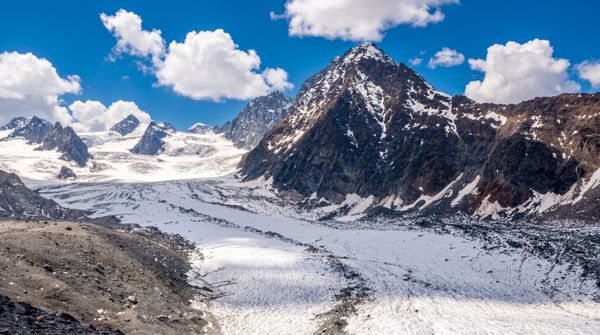
The following day offers the chance to approach and even touch a massive glacier, providing a striking reminder of the ancient forces that shaped the surrounding landscape.

Hikers seeking a shorter but more demanding circular route in the same region may consider the Tour de la Vanoise, a level 3 trek that overlaps with this route for approximately a day and a half, though in the opposite direction.

01·Day by day

5 hiking days

Day01
Tignes → refuge de la Leisse
Grade
2
Length
12.09 kmkm
Ascent
689 mm
Descent
291 mm
Time
04:17
Your trek begins in the square opposite the tourist office in Tignes, where buses and taxis arrive. To the left of the office, a metal staircase leads up to a large park overlooking the beautiful Lake Tignes. Look for the “Le Lagon” sign above the stairs, marked with the figure of a climber. Follow the lakeshore westward, keeping the lake on your right. On the western bank, you will join the GR55 trail, marked in red and white, which will accompany you all the way to the end of the trek in the town of Modane.

Continue toward the ski village of Val Claret, following Avenue du Lac until you reach the square at the entrance to the ski station. Turn left onto Val Claret Street and continue carefully along the bike path, which gradually becomes a sidewalk. Turn left again and take the dirt road climbing gently uphill. This gradual ascent leads to the Chalet de la Leisse at an altitude of 2,216 meters.

Pass the chalet and, at the sharp bend, turn right. Shortly afterward, turn right again onto the trail climbing through the Vallon du Paquis. This section offers an excellent opportunity to observe the striking geological contrast between the two sides of the valley, which lie along a fault line. The slopes on your side are composed mainly of softer rocks, including gypsum and dolomitic conglomerates, creating broad and gentle terrain well suited to skiing. Across the valley, the landscape changes dramatically to steep limestone cliffs known as the Rochers de la Petite Balme.

The trail continues beneath the Refuge du Prariond, and shortly afterward reaches the junction for the Col de Fresse at an altitude of 2,531 meters. Continue straight ahead on the red-and-white GR55 trail as it winds between the massive ridges of Grande Motte on the right and Pointe du Grand Pré on the left. From here, the terrain becomes rockier and the ascent more demanding. The path can be faint and poorly marked in places, so it is important to pay close attention to the cairns that guide the way toward the Col de la Leisse at 2,761 meters. Early in the season, some snow crossings may still be present near the pass.

From the col, look north toward the towering walls of Grande Sassière, formed from dark, gleaming slate rock. The descent begins through an area of loose scree where the trail again becomes less distinct, requiring careful attention to the cairns. Continue along the eastern shore of Lac des Nettes until reaching its southern end.

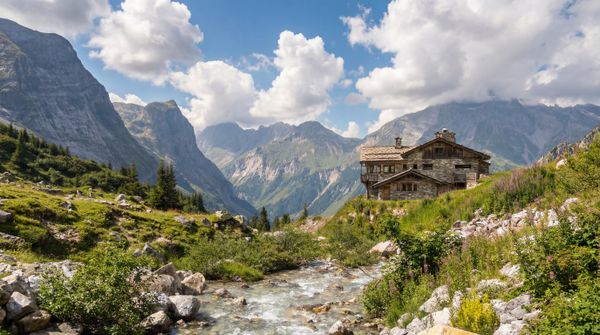
Beyond the lake, the landscape opens into broad alpine meadows where marmots are commonly heard whistling among the grasses and rocks. The trail becomes clearer again as it crosses the Plan des Nettes, an area that was once covered by a lake, following the right bank of the stream. Shortly after passing a narrow section where a small dam once stood, you will arrive at the Refuge de la Leisse at 2,487 meters, your accommodation for the night.
Crossing Vanoise (GR55) - 2
Day02
refuge de la Leisse → Refuge du Col de la Vanoise
Grade
2
Length
10.35 kmkm
Ascent
432 mm
Descent
401 mm
Time
03:21
Leave the hut and continue west along the trail. Before long, you will cross to the left bank of the Torrent de la Leisse. The Leisse Valley is well known for its large marmot population, and throughout this section you will likely hear their characteristic whistles echoing across the valley and may spot some among the rocks and alpine meadows.

As the trail continues westward beneath the imposing summit of Grande Casse, rising to 3,855 meters on your right, keep an eye on the scree slopes descending from the mountain. This is one of the best areas along the route to spot Alpine ibex, known in French as bouquetins. They resemble Nubian ibex but are more heavily built, with thick coats ranging from dark brown to silvery gray and long ridged horns curving backward from their heads. You may also encounter chamois, smaller and more agile animals with short curved horns and distinctive two-toned faces, white around the neck and dark brown or black around the eyes and muzzle.

The trail gradually descends beside the lively stream until reaching the stone bridge Pont de Croé-Vie at an elevation of 2,099 meters. This historic bridge crosses the Torrent de la Leisse at a narrow point in the valley. Its name comes from the local Savoyard patois and means “narrow passage.” Beginning in the 16th century, this crossing formed part of an important salt route linking the Tarentaise and Maurienne valleys, and numerous armies passed through the area over the centuries.

Hikers spending the night at Refuge d’Entre Deux Eaux should not cross the bridge. Instead, continue south along the trail for approximately fifteen minutes to reach the hut. Those continuing to Refuge du Col de la Vanoise should cross the bridge and begin the steep ascent beyond it. The trail climbs in a series of zigzags, and during the alpine flowering season, usually in the first weeks of July, the slopes are often covered with blooming purple rhododendrons.

As you climb, look toward the slopes of Montagne de la Réchasse ahead. This is another excellent location for spotting ibex and chamois, sometimes surprisingly close to the trail itself. After an ascent of 311 meters, you will reach the junction known as Voûte du Clapier Blanc at 2,410 meters, near a stone memorial dedicated to two French army engineers who died here on August 23, 1932. Ignore the nearby sign indicating 2,300 meters, as the marked elevation is incorrect.

The trail branching left climbs southward along the eastern slopes of the Réchasse plateau before eventually joining the GR5, the long-distance route crossing the French Alps from Lake Geneva to Nice. This section also forms part of the Tour des Glaciers de la Vanoise, which overlaps with your current route for approximately a day and a half in the opposite direction.

Continue instead on the trail turning right toward Refuge du Col de la Vanoise. The route passes an old bunker at 2,439 meters before climbing gradually westward. Follow the Ruisseau de la Vanoise and cross it at 2,445 meters, then continue past the small Lac Rond. From there, a final gentle ascent leads to the Col de la Vanoise at 2,518 meters, where you will find Refuge du Col de la Vanoise, your accommodation for the night.


Crossing Vanoise (GR55) - 3
Day03
Refuge du Col de la Vanoise → Refuge du Roc de la Pêche
Grade
2
Length
15.19 kmkm
Ascent
536 mm
Descent
1136 mm
Time
04:43
Most of this stage follows a long and pleasant descent toward the ski town of Pralognan-la-Vanoise, before the route gradually climbs again to your accommodation for the night. The trail passes through the broad glacial valley of the Grande Casse, surrounded by steep and dramatic rock walls shaped over thousands of years by an ancient glacier that once filled the entire valley. Traces of this glacial activity can still be seen in the smooth rock formations and carved slopes throughout the landscape.

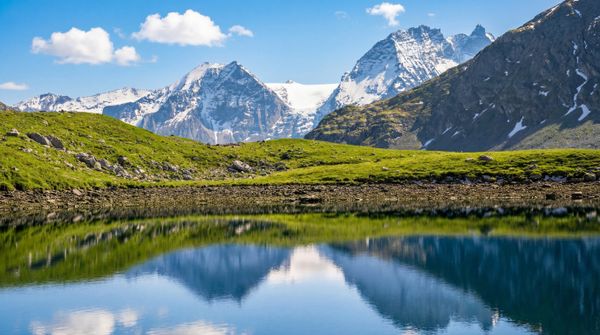
Leave the hut along the wide trail following the western shore of Lac Long, which, despite its name, is more rounded than elongated. Shortly after passing the lake, the route descends steeply in a series of tight zigzags through scree slopes toward Lac des Vaches at 2,319 meters. This lake is one of the highlights of the trek and an excellent place to stop for photographs. The most striking view appears behind you as you cross the lake on a line of large stepping stones placed specifically for hikers. During the alpine flowering season, usually in the first half of July, the lake may also be covered with white cotton-grass flowers known in French as linaigrette.

Continue descending as the trail gradually widens, reflecting the popularity of this section among day hikers. About 750 meters beyond the lake, and approximately 100 meters lower in elevation, you will reach the Passerelle du Chanton bridge at 2,210 meters. Crossing the bridge marks your exit from the Vanoise National Park.

The route continues gently downhill past the Chalets de la Glière at 2,030 meters before crossing the Torrent de la Glière at 2,012 meters and reaching Refuge des Barmettes at 2,010 meters. This refuge is well known for its mountain restaurant and makes an excellent stop for lunch, coffee, or cake.

From Refuge des Barmettes, continue west beneath the cables of the Génépy ski lift. The trail remains wide and comfortable, following the edge of the ski slope down toward the hamlet of Fontanettes at 1,644 meters. From here, continue descending along paths that cut across the bends of the road, passing through Les Bieux and eventually reaching the hamlet of Barioz at 1,418 meters, beside the center of Pralognan-la-Vanoise. This is the lowest point of the entire route. The town offers numerous opportunities for food, rest, and supplies for those who did not stop earlier at Refuge des Barmettes.

Leave Pralognan heading south along the road toward the camping area and the edge of the Forêt d’Isertan. The trail follows the right bank of the Torrent de Chavière, first along the forest edge and then through woodland until reaching the Pont de Gerlon at 1,592 meters. Between Pont de Gerlon and Pont de la Pêche, the route crosses open alpine meadows that, during the flowering season, are covered with a wide variety of colorful wildflowers.

The trail continues to the hamlet of Prioux at 1,711 meters. From there, stay on the left bank, cross the Passerelle des Anciens, and continue along the right bank of the Doron de Chavière river. Follow the road for approximately 500 meters before turning right toward Pont de la Pêche at 1,764 meters. After crossing the bridge, the route begins climbing steadily along the left bank through alpine meadows at the bottom of the valley.

Ignore the trail branching right toward the Col du Mône beneath Petit Mont Blanc, the prominent peak rising to your right, and continue straight ahead along the main valley until reaching Refuge du Roc at 1,910 meters, your accommodation for the night.


Crossing Vanoise (GR55) - 4
Day04
Refuge du Roc de la Pêche → Refuge de Péclet-Polset
Grade
2
Length
5.89 kmkm
Ascent
557 mm
Descent
5 mm
Time
02:32
This is the shortest stage of the trek and is intentionally designed to leave time and energy for an optional excursion after reaching the hut, including the opportunity to view one of the glaciers of the Vanoise.

Leave the hut and continue south along the gently ascending trail. After approximately one kilometer, you will pass Chapendu Hut on your left. Another kilometer farther, after crossing a small bridge to the left, brings you to Alpage de Ritord at an elevation of 1,972 meters.

This alpine farm is run by Suzanne and Félix Galiz, who raise a small herd of around forty cows grazing freely in the surrounding meadows. They produce and sell their own dairy products on-site, including Beaufort AOP “Chalet d’Alpage,” Tomme, and Raclette cheeses. The Beaufort is especially recommended and is often less expensive here than in shops elsewhere in the region. The farm also operates as a small café and makes an excellent stop for brunch or a break if you skipped breakfast earlier in the day.

Alpage de Ritord is also the final location along the route where overnight camping is permitted for hikers traveling with tents.

Beyond the farm, the trail continues gradually uphill through the small valley of the Doron de Valpremont. Along the way, you will pass the ruins of Mollaret d’en Bas and later the ruins of La Rama before reaching Refuge de Péclet-Polset at 2,474 meters, your accommodation for the night.
After arriving at the refuge, it is highly recommended to leave your backpack at the hut and continue with only water and essential items to the nearby Lac Blanc (“White Lake”), located about fifteen minutes above the refuge. Its grassy shores provide an ideal place to rest or picnic while surrounded by dramatic alpine scenery.

From the lake, more experienced hikers can continue to the Col du Souffre at 2,819 meters, involving an ascent of approximately 400 meters over 3 kilometers from the refuge. The pass offers impressive views toward the Glacier de Gébroulaz, one of the major glaciers of the Vanoise massif.

The trail descending northwest from the pass continues toward Refuge du Saut, but by descending roughly 110 meters from the col, it is possible to approach the glacier itself very closely.

Walking on glaciers without proper equipment and an experienced guide is extremely dangerous and should not be attempted. Return to Refuge de Péclet-Polset by the same route.

Crossing Vanoise (GR55) - 5
Day05
Refuge de Péclet-Polset → Modane
Grade
2
Length
13.53 kmkm
Ascent
374 mm
Descent
1774 mm
Time
03:60
Descend from the hut back to the GR55. From here, the trail begins a steady climb, gradually entering high alpine terrain where patches of snow may remain even late in the season. Cross these sections carefully and follow the cairns as the route continues its gradual ascent. The final approach becomes steeper, crossing large boulder fields, but does not present technical difficulties. The climb leads to the Col de Chavière at 2,796 meters, the highest point of the trek.

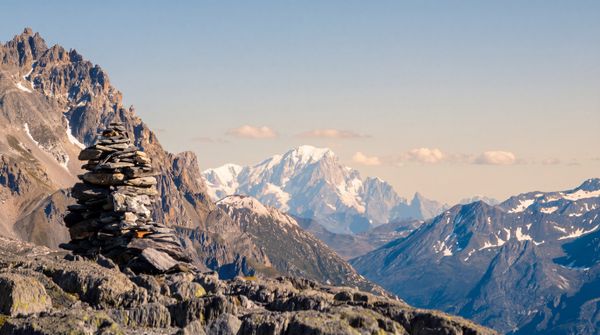
From the pass, pause to take in extensive views over the Vanoise glaciers, as well as surrounding mountain ranges, including the Mont Blanc massif visible in the distance behind you.

The descent begins over a slope of loose boulders, where it is essential to continue following the cairns. The trail then enters a glacial cirque on the left, where Lac de la Partie can be seen below. Continue descending to a small plateau at 2,504 meters, where a trail junction is located. Take the right-hand path.

From here, the route descends more steeply across the area known as Grand Planay. This section also offers good opportunities to observe Alpine ibex on the surrounding slopes. The trail continues downward and eventually enters forest, following the left bank of the Ruisseau de Saint-Bernard. It passes through the hamlet of Polset at 1,830 meters, where a small chapel and well-preserved traditional chalets are located.

Continue to the next junction, turn left, cross the D106 road, and continue straight ahead on the path beyond. The trail resumes its descent along the left bank of the Ruisseau de Saint-Bernard, passing additional chalets before opening into a series of wide forest zigzags. At the junction in Combe à Sile, continue following the descending path.

The route then leads down to the center of Modane, the final destination of the GR55.

02·Map room

Route map & GPX files

Download GPX
03·FAQ

Before you set out

How to get there?

Everything you need to get from the city with the closest international airport to the start of the trek.

From Lyon Part Dieu train station, take a TER train (departing once an hour) that will bring you in 1 hour and 26 minutes to Chambery Challes Les Eaux station. From there, take another TER train that will take you in 1 hour and 47 minutes to Bourg Saint Maurice.

From Bourg Saint Maurice, take a bus that will bring you to your starting point in front of the tourist office of the ski town of Tignes in about 55 minutes. Note: Buses from Bourg Saint Maurice to Tignes are not frequent during the summer season, so it is recommended to take a taxi from the Bourg Saint Maurice train station (costing around 45–60 euros for your group), which will get you to the starting point in just 43 minutes. There are also more expensive taxi services that can take you directly from Lyon Airport to the starting point in about 3 hours, at a total cost of around 400 euros.

Renting a car is not recommended for this route, as it is not circular and returning to your car would take more than 5 hours and be quite costly. The return journey from the endpoint to Lyon is simpler and faster, taking about 2 hours and 20 minutes by direct train.
How to get back?

Everything you need to know to get back from the trek's end point to the city you came from.

From the Modane train station, the endpoint of your trek, take a direct high-speed train that will bring you in 2 hours and 20 minutes to Lyon Part Dieu station. Please note, the high-speed trains to Lyon depart at 08:50 in the morning and 18:12 in the evening. Slower trains are available at other times.
Where to sleep?

A hotel room, refuge, or tent? All the options for this hike including tips, guidelines, and a summary of local rules around bivouacking.

Camping: On this route, it is possible to camp for a symbolic fee near some of the huts, but not everywhere. On the second day, you will need to continue past Col de la Vanoise Hut to the Barmettes Hut. On the third day, you will need to continue from the Du Roc Hut to the area near the Ritort Hut. This will be the last point along the route where camping is allowed, so if you plan to camp only, the route will take four days instead of five.

Hut accommodation: Staying in huts along this route is highly recommended. The huts are known for their quality and hospitality. The hut on the third day (Du Roc) is particularly comfortable and offers amenities such as a Scandinavian bath, sauna, and barbecue area (meat can be purchased on-site.) Although availability in most huts is relatively good compared to other areas in the Alps, it is strongly advised to book in advance before the hiking season begins (mid-June to mid-September).
Good to know:

Important info, enrichment details about the hike, interesting anecdotes, recommendations, food, culture, and more to make your trip more successful.

Reaching the starting point of the trek requires a bit of planning, as it usually involves several train connections and, in some cases, a short taxi ride. The return journey, however, is relatively simple and convenient. Renting a car is generally not recommended unless you are able to return it in Tignes, where the route begins. Public transportation provides efficient access to the starting point from Lyon, Turin, and Geneva, all of which are easily accessible by air.

The route follows the GR55 trail, marked throughout with the classic red-and-white waymarks. This section of the French Alps is well known for its wildlife, and hikers often have a good chance of spotting Alpine ibex, known in French as bouquetins, as well as chamois moving across the rocky slopes. Chamois are smaller and more agile, with short curved horns and distinctive two-toned faces, white around the neck and dark brown or black around the eyes and muzzle. Alpine ibex are larger and more heavily built, with thick coats ranging from dark brown to silvery gray and impressive curved horns.

Another characteristic animal of the region is the Alpine marmot, whose sharp whistling calls are commonly heard throughout the green valleys and meadows along the route.

The fourth day of the trek is intentionally kept short, allowing hikers the opportunity to approach the Glacier de Gébroulaz, one of the highlights of the region. The optional excursion begins directly from the hut where you will spend the night and climbs approximately 400 meters over a distance of 3 kilometers. The glacier was once the only privately owned glacier in France and is now protected as part of the Vanoise National Park.

It is important to note that walking on glaciers without proper equipment and an experienced guide is extremely dangerous and should not be attempted.