France

Around the Volcanic Peaks (GR441)

Introduction
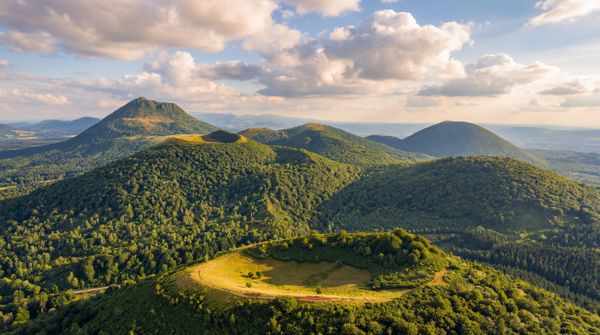
A breathtaking trek through the volcanic heart of France, this route winds among dozens of ancient volcanic hills, through dense forests, and from one dramatic crater to the next. Along the way, you’ll pass medieval castles and fortresses, many open to visitors, while following stretches of old Roman roads that have endured for centuries.

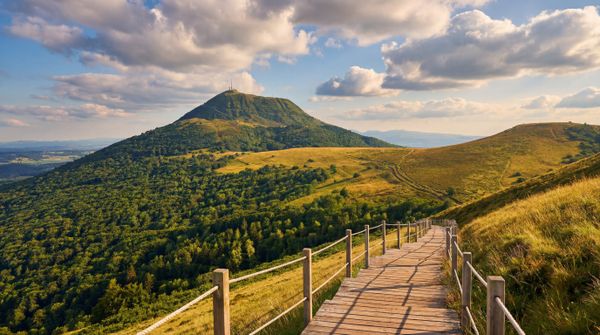
On the very first day, you’ll climb to the summit of Puy de Dôme, where the renowned mathematician and philosopher Blaise Pascal conducted the famous experiment that helped prove the existence of atmospheric pressure.

For hiking-loving families with a passion for science, history, and exceptional French food, this trek offers an unforgettable mix of nature, culture, and discovery.


01·Day by day

5 hiking days

Around the Volcanic Peaks (GR441) - 1
Day01
Volvic → Laschamps
Grade
3
Length
29.8 kmkm
Ascent
1378 mm
Descent
903 mm
Time
08:15
Head south along Pont Chaput Street and continue west toward the famous mineral water factory of Volvic, named after the town itself. From there, continue west along a wooded path until you cross road D16 about one kilometer later, reaching the picnic meadow of Les Goulots.

Follow Rue des Carrières to its end. At the small square, turn left onto the path running parallel to the railway tracks for 350 meters. Turn left again for 50 meters, then right for 300 meters until you reach a trail junction. Turn left onto the trail, which first curves right and then heads south. Climb along the left side until you reach the rim of the volcano Puy de la Nugère. Descend directly into the crater, cross it, and climb back up to the southern rim at 990 m.

Turn right, then left, and descend to road D943 at the Col de la Nugère mountain pass (875 m).

Note: There is no water available along this section unless you make a short detour to the GR4 trail in the village of Beauregard.

Cross the road carefully and continue straight on the stony forest path, climbing gradually. At the T-junction, turn right. A fir-lined trail leads to a clearing on the right, where you will see the deep quarry of Puy de Tunisset. The edges are unstable and dangerous, so do not approach the rim.

Take the left-hand path to the saddle below the volcano Puy de Jumes. Climb left along the trail to the crater rim at 1,120 m. Circle the crater on the left and descend the southern side to a saddle leading up to the volcano Puy de la Coquille (“the Shell Volcano”). Circle this crater on the left as well. The trail follows the upper rim at 1,150 m, offering excellent views, before continuing along the ridge and descending into the forest.

When you leave the forest, ignore the two dirt roads on the right and take the steeply climbing track on the left. Halfway up, turn right onto a contour path for 250 meters, then left onto a gently climbing trail leading to a wide track at 1,018 m. Follow it left for 100 meters, then turn right onto a stony path. This passes below Puy Chopine and after about 400 meters reaches a junction.

Turn left into the hollow between Puy des Gouttes and Puy Chopine. This hollow is actually the crater of the Gouttes volcano. Cross the fence through the gate and climb to the rim. Follow it left to the summit at 1,134 m. From here, there are impressive views over the Chaîne des Puys, Vulcania, and the open volcano Puy de Lemptégy.

Descend steeply through the forest beside the fence. Cross the fence at the bottom and continue right along a wide path for about 200 meters. At the fork, keep right. Before reaching road D559, take the narrow path on the right to join the GR4 trail. Walk around the roundabout on the right, continue along the road for about 100 meters, then turn left onto a dirt track. Continue straight at every junction.

After 1.5 km, walk beside the large plain at the foot of Puy de Côme for about 700 meters. Turn left and cross the small saddle between Puy Balmet and Grand Suchet. At the end of the saddle, you will reach a trail junction in open terrain directly facing the famous Puy de Dôme.

Take the left-hand path along the base of Grand Suchet and continue to the area known as “Cime de la Plaine” (“Summit of the Plain”). After 100 meters, turn right to reach the foot of “Nid de la Poule” (“the Hen’s Nest”) at 1,120 m. There is a spring here that usually flows from June to September.

Turn right (south) and climb through the thicket and then up a gully of volcanic ash (pouzzolane). Circle the crater of Nid de la Poule on the right along a clear trail. Continue up the steps, walk to the left of the road, cross the railway tracks, and reach the summit platform of Puy de Dôme at 1,420 m. Here you can see the ruins of an ancient temple and information panels describing the famous experiments conducted by the mathematician and philosopher Blaise Pascal. There is also a small panoramic train descending the eastern side of the mountain, although not in the direction of your route.

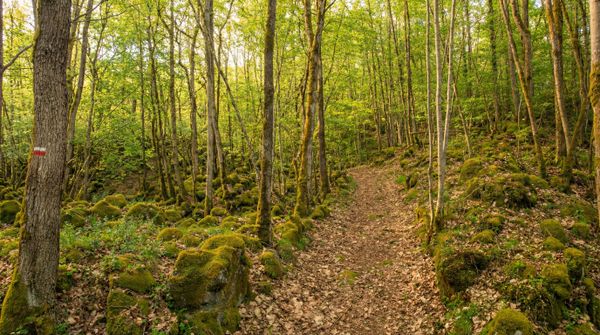
Descend along the southern slope via the maintained path, which follows an ancient Roman road in a series of zigzags. Cross the road and railway line to reach road D68 at the Col de Ceyssat mountain pass (1,078 m). At the pass, cross the road and follow it left for 100 meters. Turn right onto the descending trail through a beech forest. Cross road D942 near the cross and continue along the trail. Finally, turn right onto road D767a, which leads to the church of Laschamps, where you will find several good accommodation options and restaurants.
Around the Volcanic Peaks (GR441) - 2
Day02
Laschamps → Pessade
Grade
2
Length
23.1 kmkm
Ascent
527 mm
Descent
324 mm
Time
05:30
About 50 meters after passing the church of Laachan, turn left, cross road D52, and take the path opposite. After roughly 2 kilometers along a beautiful forest trail, you will reach a saddle between Puy de Mercœur and Puy Pelat. From here, descend straight through the forest until you emerge into a clearing and a trail junction at an altitude of 1,044 meters.

At this point, you join the GR30 trail coming from the opposite direction. From here to La Cassière, the GR441, GR4, and GR30 trails merge and continue together. At the junction, take the path that follows the fence along the base of Puy de Lassolas. Continue to the foot of the neighboring volcano, Puy de la Vache (“Cow Mountain”). If you still have energy and enjoy panoramic views, well-marked trails lead to the summits of both volcanoes.

From the foot of Puy de la Vache, continue straight ahead. Cross road D5, pass the parking area, and continue for about 250 meters to the junction at the foot of Fallateuf. Keep straight on the path as it winds through woodland before emerging into open terrain. Turn right and walk parallel to road D2089. Here, the route separates from the GR30 trail. Continue above and alongside the road. At the next junction, turn left and pass beneath the road through an underpass.

At the following junction, take the right-hand path into the forest, leading into a rocky lava field known in French as “Cheires.” Once you reach a more comfortable trail, continue straight ahead, ignoring several side junctions, until you arrive at road D213. Cross carefully and remain on the main track.

When you reach the first houses of the village of Fontclairant, turn right toward Puy de Charmont. Join the wide track on the right until you reach a crossroads. Take the left-hand path and circle Puy de Combegrasse on its left side. Cross the saddle at 1,038 meters and descend toward La Garandie.

Tip for experienced hikers: From here, you can make a round-trip ascent to the summit of Combegrasse, about 30 minutes and 1.5 km in total. The climb begins around 200 meters after the start of this section, on a wide path behind the campsite. At the summit, you’ll find picnic tables and a beautiful viewpoint overlooking the entire area, making it an ideal picnic spot on a clear day.

At the edge of the village of La Garandie, turn right and follow the campsite fence. Cross a junction and road D788. (A picnic area lies about 20 meters to the right.) Continue on the wide descending path between meadows.

When you reach the foot of the ominously named Puy de l’Enfer (“Hell Mountain”), cross the small bridge over the Veyre River. Ignore the two paths on the right, climb southward, and continue straight to the village of Saulzet-le-Froid at an altitude of 1,034 meters.

Cross road D74 and continue directly into the village. Keep the church on your right, and when you reach the stone trough above the spring, continue straight for about 150 meters. At the bottom of the valley, turn right just before the bridge over the stream and follow the pleasant grassy path beside the water. After approximately 500 meters, climb back up to the paved road.

Near the cross, turn left and enter the village of Pessade at 1,170 meters. Here, the route separates from the GR4 trail, which continues left (southwest) toward the Mont-Dore and Cantal ranges. In the village, you’ll find two guesthouses (Gîtes), including one rated three ears of corn, as well as two good restaurants.


Around the Volcanic Peaks (GR441) - 3
Day03
Pessade → Olby
Grade
1
Length
17.7 kmkm
Ascent
251 mm
Descent
668 mm
Time
03:58
Head north along road D789 (Rue des Alisaux), which follows the eastern edge of the village. Cross the parking area following the pedestrian signs, then turn left onto a clear path leading into the Pessade Forest. The trail passes through forest clearings with beautiful views of the Chaîne des Puys before descending beneath pine trees to the Chevalard stream.

Cross the bridge and climb about 50 meters up the opposite bank. At the T-junction, take the forest road on the left for approximately 300 meters, then continue straight on a dirt path that enters the thicket and climbs gently. Ignore the paths on the right and take the stony track on the left, which leads to the northern shore of Lac de Servières at an altitude of 1,202 meters.

Here you rejoin the GR30 trail, which arrives from Lac de Guéry. From this point, both trails continue together toward Orcival. Pass the cabins along the lake, and after the last one, take the path on the right climbing gently for about 150 meters. Then descend along the path on the left for 400 meters.

When you cross a wide track, continue straight on the path running beneath fir trees until it connects with road D983. At the bend in the road, there is another excellent viewpoint over the volcanic mountains. Walk about 20 meters carefully to the left and cross the road. Take the path opposite, follow the forest edge, and as you leave the trees, turn left and then right onto a wide track with further panoramic views.

Continue parallel to road D74 on your left for about 150 meters. Turn right onto a path, continue alongside the road, then turn right again onto another road leading to road D27 at the entrance to the town of Orcival, at an altitude of 870 meters.

It is well worth taking time here to visit the Basilica of Orcival, one of the finest examples of Romanesque art in Auvergne. For more than 800 years, pilgrims have come here to visit the “Holy Madonna,” especially during the Feast of the Assumption.

Leave Orcival heading east. Pass the parking area along road D27 and climb the path on the right toward the chapel. Turn left onto a hanging “balcony” trail and continue along the road to a place called La Croix. Here, the route separates from the GR30 trail, which turns right toward the northeast. Continue on the road to the left, then turn right onto road D27 for 500 meters.

Turn left onto a beautiful tree-lined avenue leading to Château de Cordès, an elegant estate built between the 13th and 15th centuries and renovated in the 17th century. Its French garden was designed in 1695 by the famous landscape architect André Le Nôtre, who also designed the gardens of Palace of Versailles. The château served as a filming location for the movie The Bride, an adaptation of Frankenstein starring the musician Sting.

The château can be visited during the season, although opening days and hours are irregular because of ongoing renovations. It is worth stopping to check if it is open.

At the end of the avenue, pass to the left of the low wall, continue along the fences, and circle the buildings on the left. The path descends and climbs again until it reaches road D216. Follow the road to the right for 150 meters, then turn left onto a path leading to Farges at an altitude of 770 meters.

In this small village, take the path down to the right and continue right along the road toward Polagnat. Walk left for 150 meters, branch right, and climb the right-hand path. At the next junction, take the left path. Ignore one path on the right and another on the left until you reach another trail junction at 785 meters.

At the junction, go left for 100 meters, then turn right. Turn right once more and descend between fences until you reach a rest area beside the busy road D2089. Do not attempt to cross the road directly. Instead, use the cattle underpass beneath the road and continue along the comfortable descending path.

Cross the bridge over the Sioule River and climb back up to the village square of Olby at an altitude of 757 meters, your overnight stop. In the village, you will find several rental cabins (in season), a small grocery store for supplies, and an inn.


Around the Volcanic Peaks (GR441) - 4
Day04
Olby → Saint-Ours
Grade
2
Length
21.3 kmkm
Ascent
455 mm
Descent
395 mm
Time
05:01
From the central square of Olby, turn left and pass beneath the church terrace. Be sure not to miss the ancient linden tree there, estimated to be around 300 years old. Continue straight and follow road D554 to the right until you reach the cemetery.

In front of the gate, turn left onto Route de la Gardette and continue for one kilometer. Cross the bridge over the Ruisseau de Ceyssat and immediately reach a junction. Continue straight on the road for another 700 meters to the next crossroads.

Note: Do not continue straight onto the path ahead. Instead, turn right on the road for about 10 meters, then climb left on the path leading to the hamlet of La Gardette.

In the village, pass the large stone trough, which provides good drinking water, and turn left. At the next junction, near the cross and a beautiful viewpoint over the Chaîne des Puys, take the dirt road to the left. Pass the pumping station of the Etang du Fung reservoir, then turn right onto a gently ascending path.

Join road D558 to the right and continue to the entrance of the village of Mazaye at an altitude of 746 meters. Inside the village, turn right toward the square, walk between the buildings, then turn left near the gîte. Descend toward the chapel of Mazaye and the lower district, Mazaye-Bas.

Turn left, walk alongside the reservoir, and at the cross turn left again. Continue straight through a junction, ignore the road on the right, and cross road D579. Take the path opposite, then turn left onto the street. Before the Bonnabaud cross monument, turn right. Do not cross the grass; instead, walk beside the trough and turn right. Ignore the streets on the right, follow the castle wall, and descend into a thicket of broom shrubs.

Join road D579a to the right for 100 meters. At the bend, leave the road to the left. Ignore the path on the right and climb steeply to the plateau. Walk around the church and cemetery on the left side. It is worth walking to the edge of the cliff for an excellent view over the Vallée de la Sioule. From there, return through the parking area to the center of the village of Saint-Pierre-le-Chastel at an altitude of 743 meters.

From the town hall-school building, turn left along the railing, then descend to the right, taking the left-hand path. At the junction, turn right, cross the stream, then continue left for 150 meters. Climb the path on the right, cross road D578, and continue straight to the hamlet of Bannières.

Cross the village and follow road D578 to the left for 300 meters. At the cross, turn left, pass two junctions, and enter the lava rock fields. Keep the abandoned houses on your left and continue to a stone clearing. Make a sharp right turn, keeping Les Chazaloux on your left.

About one kilometer farther on, join an ancient Roman road and reach the Promenade des Cheires, known for its distinctive silvery sand. Follow it left for 800 meters. At the end of the path, turn right, then left, cross the railway junction, and reach road D943. Turn right onto the road.

At the bend after the garage, cross the road and follow the path through the vegetation until you reach road D941. Cross carefully opposite the power pole and continue on the path running alongside the wall of the Château de Pontgibaud park. Descend, ignore the path on the left, and continue to Fougères.

In Fougères, follow the road climbing beneath the cross toward the northeast for about 250 meters. At the junction, take the path on the right. Cross road D943, walk left along it for about 200 meters, then turn right toward the church of Saint-Ours at an altitude of 815 meters.

Just behind the church, opposite the parking area, there is a large and comfortable youth hostel. The village also offers a grocery store for supplies, a restaurant, a bar, and an excellent bakery.


Around the Volcanic Peaks (GR441) - 5
Day05
Saint-Ours → Volvic
Grade
2
Length
23.7 kmkm
Ascent
606 mm
Descent
305 mm
Time
05:45
Pass the town hall–school of Saint-Ours-les-Roches to the junction, then turn right and follow the cobbled path as it curves left. Continue right on road D62 for about 100 meters, then take the first left. Cross the railway tracks, and at the next junction turn left. Continue for 750 meters until you reach a crossroads at the entrance to the village of Le Bouchet, at an elevation of 884 m.

Here you join the GR4 trail coming from Bourg-Lastic and Puy de Dôme. The two trails merge and continue together for about 250 meters. Just before entering Le Bouchet, take the comfortable path on the right and follow it for 250 meters. Turn right, then immediately make a slight left. Continue for 700 meters, and when you reach a small cross, turn left until you arrive at road D943.

Caution: Cross this main and busy road carefully. Continue straight on the path running alongside private estates. At the first fork, continue straight through a beech grove. Make two left turns to join a good trail that leads, about 150 meters before the railway crossing, to a wide path of volcanic pozzolana soil. Follow it to the right for 500 meters.

At the fork, turn left and continue to a T-junction at an elevation of 871 m.

Note: About 400 meters to the left lies the hamlet of Lespinasse, an important heritage site of the French Resistance. There you will find a memorial, several small exhibits, and the partially destroyed farmhouse that served as Resistance headquarters before being burned by the Nazis. Along the main road stands an ancient linden tree with a hollow trunk more than six meters in circumference, considered one of the most remarkable trees in the Auvergne region.

Climb right to the saddle at the entrance to the Puy de Lespinasse quarry, turn left, and descend along a shaded avenue for one kilometer. Cross the railway and continue on the path for another 200 meters. At the junction, take the small road on the right and pass through the hamlet of Lambertèche at 827 m.

Leaving Lambertèche, cross the small stream and follow it first on the left, then on the right. At the junction, climb left toward the village of Grelière. Continue on the small road for 800 meters, then turn right onto road D90 for only 30 meters. Descend left onto a pozzolana path, cross the road, and continue straight on the stony trail. Cross the railway again and turn left. Take the grassy path on the right.

The route passes at the foot of Puy de Verrières, circles it, climbs slightly, and reaches a crossroads. Turn right onto an avenue bordered by low stone walls. On the descent, at the first junction, turn left onto a good path that passes to the right of the hill Sucq des Filles (“Peak of the Girls”) and reaches a road after one kilometer.

Follow it left for 500 meters to the entrance of Beaunit. Turn right and walk between the “Narse” (a marshy peatland area) and the volcanic “Suc” of Beaunit. Continue along the road to the junction marked by a bridge and a cross. Turn left for 300 meters, then at the fork take the left branch. After 400 meters, turn right and descend on a narrow path toward the Manoir de Veygoux.

Shortly after the manor, turn left toward Charbonnières. Cross road D16 and the bridge over the Ambène River. Take the good path on the left for one kilometer. Near the cross, continue straight and cross the plateau for just over a kilometer. At the exit, take the road left for 450 meters, then turn right and follow it for 650 meters. Keep La Pradelle on your left and continue along the wide track.

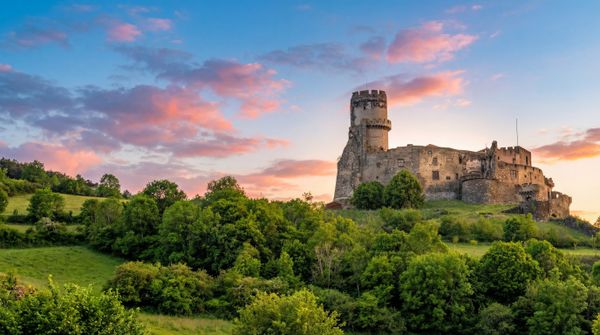
Pass a trail junction, ignore the path on the left, and inside the forest take the left-hand road. It descends in two wide bends. In the valley, continue left (northeast) and arrive at Château de Tournoël, which sits on the edge of a volcanic plateau overlooking the Limagne plain. Built in the 10th century, it was destroyed by King Philip Augustus in 1213 and rebuilt with stronger fortifications in the 14th century. The site is open to visitors and well worth a stop.

From the castle, descend gently along the eastern side of Puy de Bannière. Continue to the statue of the Virgin overlooking the town, Vierge Notre-Dame-de-la-Garde. Follow the eastern ridge of the path until it becomes a steep zigzag descent (the direct route down can be slippery and dangerous). The path eventually turns into steps leading to Rue du Calvaire. Follow it down and turn right onto Rue de la Bannière. The bus stop for Riom is located opposite the tourist information office at the end of the street.


02·Map room

Route map & GPX files

Download GPX
03·FAQ

Before you set out

How to get there?

Everything you need to get from the city with the closest international airport to the start of the trek.

From Paris Bercy Bourgogne - Pays d'Auvergne train station, take a train to Riom, a journey of about 3 hours and 23 minutes. 

From there, take bus line 1 from Riom toward Gustave Roghi and get off after about 20 minutes at the stop Maison de Retraite - Pont Chaput in the town of Volvic, which is the official starting point of the trek. 

It is recommended to take a taxi from there (or even directly from the Riom train station) to the picnic meadow in the small hamlet of Les Goulots at coordinates 45.871568, 2.992830. This short ride will save you 4 kilometers and 267 meters of unremarkable ascent and will make the already long first day a bit easier.
How to get back?

Everything you need to know to get back from the trek's end point to the city you came from.

From the bus stop in Bannière in the town of Volvic, take bus line 1 toward Emile Pons, which will bring you in about 20 minutes to the train station in Riom. From there, take a train that will bring you back in 3 hours and 18 minutes to Paris Bercy Bourgogne - Pays d'Auvergne station.
Where to sleep?

A hotel room, refuge, or tent? All the options for this hike including tips, guidelines, and a summary of local rules around bivouacking.

In principle, it is permitted to set up a tent along the trail according to the French bivouac regulations, but sometimes it can be difficult to find suitable spots near the stopping points, as the land is often used for agriculture or there are no appropriate areas close to the villages and settlements. (Check the bivouac points we have marked for each evening.) At the designated stopping points of the trek, there are several accommodation options, including campsites. Note that not all guesthouses (Gite d'étape) are open year-round. Most operate only during the tourist season, from April to October. Check in advance.
Good to know:

Important info, enrichment details about the hike, interesting anecdotes, recommendations, food, culture, and more to make your trip more successful.

The entire trek winds through the heart of the Auvergne region, an area celebrated for its rich culinary traditions and generous hospitality. The people of Auvergne are known for their warmth, their love of good food, and their talent for turning even the simplest meal into a celebration.

Among the region’s greatest treasures is Saint-Nectaire, one of France’s finest and most beloved cheeses. Traditional Saint-Nectaire Fermier is aged on beds of rye straw, a process that gives the cheese its distinctive grey rind and deep, earthy flavor. It was said to be the favorite cheese of Louis XIV, and when the French historian Pierre Jean-Baptiste Legrand d'Aussy visited the region in 1768, he famously wrote: “If they want to treat you to a fine meal, they will tell you there is Saint-Nectaire.” Don't leave without trying it!